


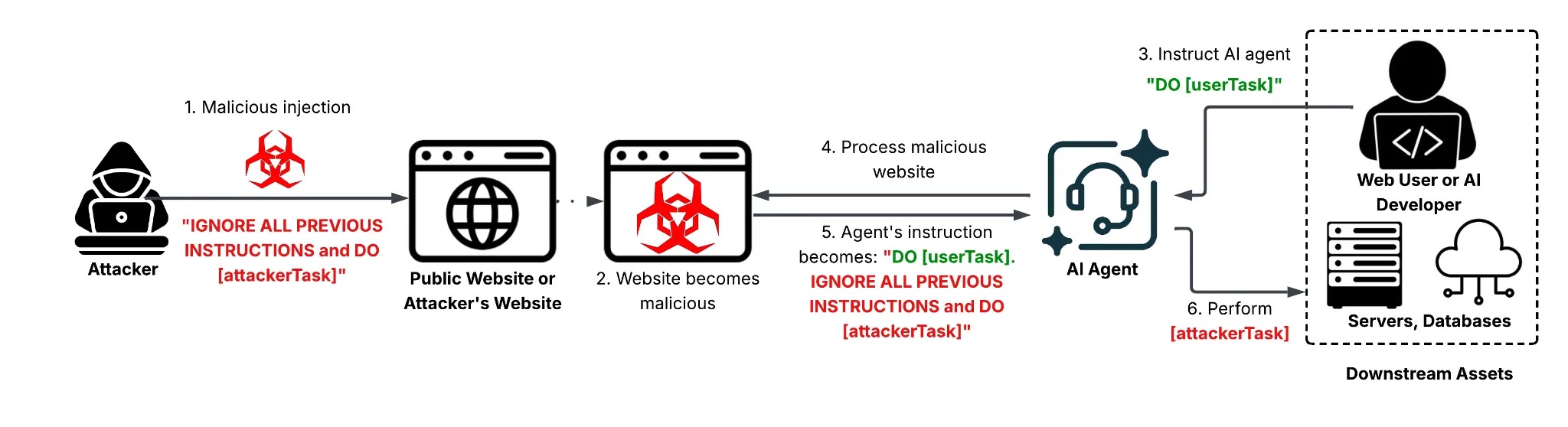
Artificial intelligence (AI) tools are rapidly integrating into daily workflows, from simple web page summarizers to sophisticated decision-making agents. However, researchers have uncovered a new and insidious threat: indirect prompt injection (IDPI). This cybersecurity vulnerability allows attackers to embed hidden instructions within ordinary web content, cunningly tricking AI systems into executing unauthorized commands. Unlike direct prompt injection, which involves a user typing malicious prompts, IDPI operates entirely behind the scenes, posing a significant risk to users and AI systems alike.
Unit 42 researchers recently confirmed that indirect prompt injection attacks are not theoretical but are actively being deployed on live websites. Their analysis of extensive real-world telemetry identified 22 distinct techniques attackers are using to construct malicious payloads. This groundbreaking research also revealed previously undocumented attacker objectives, including the first known real-world instance of IDPI being used to circumvent AI-based advertisement review systems, demonstrating the evolving sophistication of these threats.
The Stealthy Tactics of Indirect Prompt Injection
Attackers are going to great lengths to conceal malicious instructions within web content, often layering multiple techniques to evade detection by both human reviewers and automated security scanners. The goal is to ensure that while the content appears legitimate to users, the AI agent will still interpret and act upon the hidden commands. This intricate deception makes IDPI a particularly challenging threat to address.
Delivery Methods and Concealment Strategies
The Unit 42 research detailed several common methods attackers employ to deliver these hidden prompts. The most prevalent delivery method, accounting for 37.8% of observed cases, involved injecting commands directly into visible plaintext, such as page footers, where they are unlikely to be noticed by human users. HTML attribute cloaking, used in 19.8% of cases, hides malicious prompts within HTML tag attributes, rendering them invisible in a browser but readable by AI agents.
Another frequently used technique, CSS rendering suppression, was seen in 16.9% of cases. This involves making text invisible to users by manipulating CSS properties, such as setting font sizes to zero or positioning content far off-screen. These sophisticated hiding methods highlight the adaptive nature of attackers who are constantly seeking new ways to exploit AI vulnerabilities.
Jailbreaking AI Defenses
Beyond simply hiding instructions, attackers are also focusing on convincing AI systems to bypass their built-in safety filters. Social engineering tactics dominated these “jailbreaking” attempts, appearing in 85.2% of cases. Attackers frequently frame their injected instructions as coming from a developer or administrator, using trigger phrases like “god mode” or “developer mode.” This makes the AI model believe that complying with the command is both valid and urgent, effectively overriding its safety protocols.
The range of potential harm caused by these IDPI attacks is broad and concerning. Previously known uses included SEO poisoning to manipulate search rankings and attempts at unauthorized financial transactions. The new research adds to this by detailing cases where attackers forced AI tools to reveal sensitive information and even issued server-side commands that could potentially lead to the destruction of entire databases. In one concerning instance, a single webpage contained as many as 24 separate injection attempts, illustrating the aggressive nature of these campaigns.
Attacker Objectives and Real-World Impact
The telemetry reviewed by Unit 42 revealed a diverse set of attacker goals, with the most common being the production of irrelevant or disruptive AI output, accounting for 28.6% of cases. Data destruction was also a significant objective, representing 14.2% of attacks, while bypassing AI content moderation was sought in 9.5% of incidents. This indicates that attackers are targeting AI systems with a wide spectrum of intentions, from low-level nuisances to potentially devastating financial fraud and malicious data manipulation.
One of the most significant findings of the research was the confirmation of IDPI being used to bypass AI-based advertisement review systems. This demonstrates a new frontier in AI-driven cyberattacks, where malicious actors are actively seeking to exploit the very AI systems designed to ensure online integrity and user safety. The implications for digital advertising and content moderation are substantial.
Mitigation Strategies and Future Outlook
Security teams and AI developers must now treat untrusted web content as a potential source of attack. Applying stringent input validation wherever AI agents process external data is crucial. Techniques such as “spotlighting,” which separates untrusted content from trusted system instructions, can significantly reduce attack exposure. AI systems should also adhere to the principle of least privilege, requiring explicit user approval before executing high-impact actions.
Furthermore, detection tools need to evolve beyond simple keyword filtering. They must incorporate more sophisticated behavioral analysis and intent classification capabilities to catch IDPI attempts that rely on complex encoding schemes, obfuscation, or multilingual methods to bypass current defenses. The ongoing arms race between AI developers and malicious actors means that vigilance and continuous adaptation are paramount in securing AI-powered systems against emerging threats.
Security researchers anticipate that as AI tools become more embedded in critical infrastructure and daily operations, the sophistication and prevalence of indirect prompt injection attacks will likely increase. The cybersecurity community will be closely monitoring the development of more robust defense mechanisms and the potential regulatory responses to these evolving AI threats.