


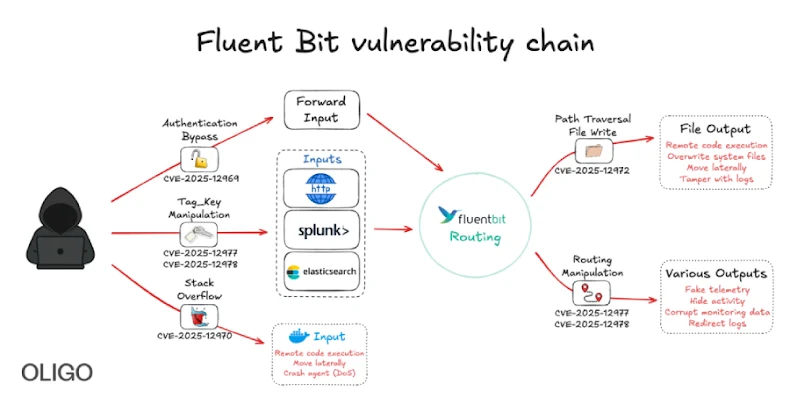
Cybersecurity researchers have uncovered five critical vulnerabilities in Fluent Bit, a widely used open-source telemetry agent, that could be chained together by attackers to gain control over cloud infrastructures. The flaws, detailed in recent security advisories, highlight potential risks for organizations relying on Fluent Bit for log aggregation and data processing in cloud-native environments.
The security defects, as reported by Oligo Security, enable attackers to bypass authentication, execute arbitrary code remotely, traverse directory structures to access sensitive files, cause denial-of-service disruptions, and precisely manipulate log tags. Exploiting these vulnerabilities could allow adversaries to deeply compromise cloud services, alter critical data, and effectively disappear after an attack by erasing their digital footprints.
Fluent Bit Vulnerabilities Threaten Cloud Infrastructure Security
The discovered vulnerabilities in Fluent Bit, an essential component for collecting and processing telemetry data in many cloud deployments, pose a significant threat to the integrity and security of cloud infrastructures. If successfully chained, these flaws could grant attackers broad access and control, impacting data confidentiality, availability, and system integrity.
According to Oligo Security, the vulnerabilities provide a pathway for attackers to not only gain unauthorized access but also to orchestrate sophisticated attacks. This includes the ability to dictate which events are logged, erase or alter incriminating evidence, inject misleading information, and ultimately mislead security responders during an incident.
Key Vulnerabilities and Their Implications
The five identified Fluent Bit vulnerabilities, several of which are assigned CVE identifiers, represent distinct attack vectors:
CVE-2025-12972: Path Traversal
This vulnerability arises from the use of untrusted tag values in generating output filenames. An attacker can exploit this to write or overwrite arbitrary files on the system, potentially leading to log tampering or achieving malicious remote code execution by overwriting critical system files or executable binaries.
CVE-2025-12970: Stack Buffer Overflow
Found within the Docker Metrics input plugin (in_docker), this flaw allows attackers to trigger code execution or crash the Fluent Bit agent. This can be achieved by creating Docker containers with unusually long names, exploiting a buffer overflow condition in the plugin’s handling of such inputs.
CVE-2025-12978: Tag Spoofing
This vulnerability affects the logic for matching tags, which are assigned to every event ingested by Fluent Bit. Attackers can spoof trusted tags simply by guessing the first character of a Tag_Key. This enables them to reroute logs, bypass filtering mechanisms, and inject malicious or misleading entries under the guise of trusted sources.
CVE-2025-12977: Improper Input Validation
Related to tags derived from user-controlled fields, this vulnerability allows for improper input validation. Attackers can inject newline characters, traversal sequences, and control characters into tag values, corrupting downstream logs and potentially impacting applications that rely on clean log data.
CVE-2025-12969: Missing Authentication Bypass
The in_forward plugin, used to receive logs from other Fluent Bit instances via the Forward protocol, suffers from a missing authentication mechanism for security.users. This allows unauthorized attackers to send logs, inject false telemetry data, and flood security products with an overwhelming volume of malicious or misleading events.
The CERT Coordination Center (CERT/CC) independently confirmed that many of these vulnerabilities require attackers to have network access to a Fluent Bit instance. Their advisory reiterates the potential for authentication bypass, remote code execution, service disruption, and tag manipulation.
Mitigation and Future Outlook
Following responsible disclosure practices, the identified Fluent Bit vulnerabilities have been addressed by the development team. Fixed versions, 4.1.1 and 4.0.12, were released last month. Amazon Web Services (AWS), which also participated in the coordinated disclosure process, has strongly advised its customers to update their Fluent Bit deployments to the latest versions to ensure optimal protection against these risks.
Given the widespread adoption of Fluent Bit in enterprise environments for log management and data forwarding, the impact of successful exploitation could be substantial. Organizations should consider implementing additional security measures beyond just updating the software. These include avoiding the use of dynamic tags for routing, strictly limiting output paths and destinations to prevent tag-based path expansion, and configuring configuration files and the `/fluent-bit/etc/` directory as read-only to prevent runtime tampering. Running the Fluent Bit service with non-root privileges is also a crucial security best practice.
This series of vulnerabilities comes more than a year after a separate flaw in Fluent Bit’s built-in HTTP server (CVE-2024-4323) was disclosed, which could also lead to denial-of-service, information disclosure, or remote code execution. Proactive patching and robust security configurations remain essential for organizations to maintain the integrity of their cloud infrastructures and protect against evolving cyber threats targeting telemetry agents like Fluent Bit.