


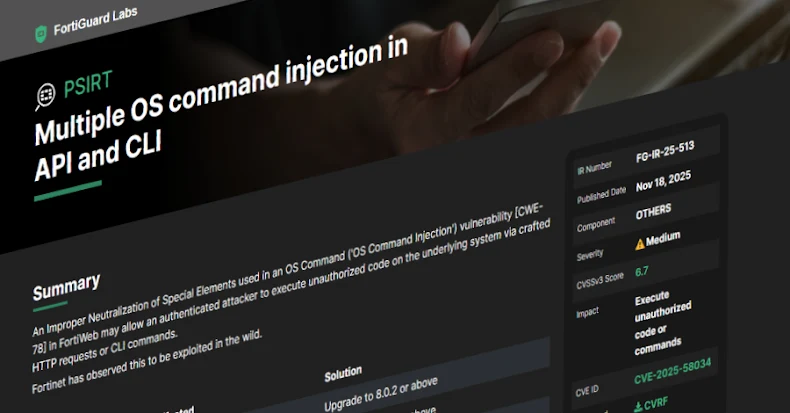
Fortinet has issued a warning regarding a newly identified security vulnerability, CVE-2025-58034, affecting its FortiWeb web application firewall. The company states that this medium-severity flaw, carrying a CVSS score of 6.7, has already been actively exploited by attackers in the wild. The vulnerability allows authenticated attackers to execute unauthorized code on the underlying system through carefully crafted HTTP requests or command-line interface (CLI) commands.
This recent disclosure follows closely on the heels of Fortinet’s confirmation that it had silently patched another critical FortiWeb vulnerability, CVE-2025-64446 (CVSS 9.1), in version 8.0.2. The tandem of these security issues raises concerns about the ongoing security posture of FortiWeb deployments and the effectiveness of vendor communication in addressing widespread threats. Security professionals are urging immediate action to mitigate potential risks.
Understanding CVE-2025-58034 on FortiWeb
The core of CVE-2025-58034 lies in an “Improper Neutralization of Special Elements used in an OS Command (‘OS Command Injection’)” flaw. According to Fortinet’s advisory, this means that specially crafted inputs are not properly sanitized before being used in operating system commands. This gap can be exploited by an authenticated attacker who can then insert malicious commands that the system executes as if they were legitimate.
It is crucial to note that successful exploitation of this vulnerability requires prior authentication. This implies that an attacker would first need to gain authorized access to the FortiWeb appliance through other means, such as compromised credentials or another exploited vulnerability, before leveraging CVE-2025-58034 to achieve command execution. This two-step process, however, does not diminish the severity of the threat, as authenticated access is a common precursor to deeper system compromise.
Mitigation and Patching Information
Fortinet has provided specific versions of FortiWeb that are affected by CVE-2025-58034 and outlines the necessary upgrade paths. Organizations are advised to upgrade to the following versions to address the vulnerability:
- FortiWeb 8.0.0 through 8.0.1: Upgrade to 8.0.2 or later.
- FortiWeb 7.6.0 through 7.6.5: Upgrade to 7.6.6 or later.
- FortiWeb 7.4.0 through 7.4.10: Upgrade to 7.4.11 or later.
- FortiWeb 7.2.0 through 7.2.11: Upgrade to 7.2.12 or later.
- FortiWeb 7.0.0 through 7.0.11: Upgrade to 7.0.12 or later.
The company credited Trend Micro researcher Jason McFadyen for responsibly disclosing the flaw through its established program. This practice of responsible disclosure is fundamental to the cybersecurity ecosystem, allowing vendors time to develop and deploy fixes before public disclosure.
Implications of Vendor Transparency
The recent revelation of CVE-2025-58034 and the prior silent patching of CVE-2025-64446 have sparked discussion about Fortinet’s communication strategy. A Fortinet spokesperson stated, “We activated our PSIRT response and remediation efforts as soon as we learned of this matter, and those efforts remain ongoing. Fortinet diligently balances our commitment to the security of our customers and our culture of responsible transparency.”
However, the practice of patching vulnerabilities without immediate public advisement has drawn criticism from security researchers. Organizations like VulnCheck have noted that such approaches can put defenders at a disadvantage. By withholding immediate information about new threats, vendors may inadvertently provide attackers with a window of opportunity to exploit vulnerabilities before defenders are aware and can implement appropriate security measures. This lack of proactive notification can hinder the ability of security teams to prepare and respond effectively to emerging network security threats.
Moving forward, the cybersecurity community will be watching to see if Fortinet refines its advisory process to provide more timely and comprehensive information alongside patches. Organizations relying on FortiWeb are strongly encouraged to review their current version status and prioritize upgrades to the latest stable releases to protect their environments from potential exploitation of CVE-2025-58034 and other emerging threats.