


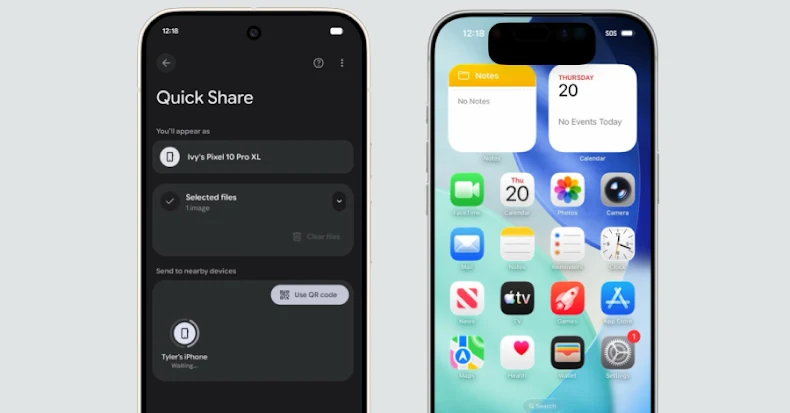
Google has significantly enhanced its Quick Share service, enabling seamless file and photo transfers between Android and Apple devices. This groundbreaking cross-platform functionality, initially exclusive to the Pixel 10 lineup, allows users to share content between Android and iPhones, iPads, and Macs. The update marks a major step towards breaking down ecosystem barriers for casual users.
Google Quick Share Bridges Android and Apple Ecosystems
In a surprising announcement on Thursday, Google revealed its updated Quick Share service now supports interoperability with Apple’s AirDrop. This feature empowers users to effortlessly share files and photos between their Android smartphones and Apple devices, a long-requested capability for many multi-platform users. The initial rollout is focused on the Pixel 10 series, with plans to extend to a wider range of Android devices in the future.
Transferring files from a Pixel 10 to an Apple device requires the AirDrop-enabled device to be discoverable to anyone. This visibility setting can be toggled for a 10-minute window. Similarly, Android device users wishing to receive content from an Apple device must ensure their Quick Share visibility is set to “Everyone” for 10 minutes or activate “Receive” mode on the Quick Share page.
Dave Kleidermacher, Google’s vice president of Platforms Security and Privacy, emphasized the rigorous security standards applied to the development of this interoperability. “We built Quick Share’s interoperability support for AirDrop with the same rigorous security standards that we apply to all Google products,” Kleidermacher stated.
Fortified Security Measures in Quick Share
At the core of the Quick Share feature’s security is a multi-layered approach powered by the memory-safe Rust programming language. Google asserts this approach creates a secure sharing channel that effectively eliminates common memory safety vulnerabilities, making the implementation resilient against attacks aiming to exploit memory errors. The company also clarified that the feature does not rely on workarounds and bypasses server routing for data transfer, directly facilitating peer-to-peer communication.
An independent assessment conducted by NetSPI in August 2025 concluded that Google’s implementation of Quick Share does not introduce vulnerabilities into the broader protocol’s ecosystem. “While it shares specific characteristics with implementations made by other manufacturers, this implementation is reasonably more secure,” NetSPI reported. “In fact, the process of file exchange is notably stronger, as it doesn’t leak any information, which is a common weakness in other manufacturers’ implementations.”
However, NetSPI’s analysis did identify a low-severity information disclosure vulnerability (CVSS score: 2.1). This issue could potentially allow an attacker with physical access to the device to access information such as image thumbnails and SHA256 hashes of phone numbers and email addresses. Google has reportedly addressed this vulnerability.
Google also indicated its openness to collaborating with Apple to enable a “Contacts Only” mode for future enhancements within the Quick Share framework.
In parallel to this consumer-facing update, Google is bolstering Android security in other key areas. The company announced that it blocked over 115 million attempts to install sideloaded apps in India that maliciously requested sensitive permissions for financial fraud. Furthermore, Google is piloting a new feature in India in collaboration with financial services like Google Pay, Navi, and Paytm. This initiative aims to combat scams that trick users into opening malicious apps during screen-sharing sessions.
“Devices running Android 11+ now show a prominent alert if a user opens one of these apps while screen sharing on a call with an unknown contact,” explained Evan Kotsovinos, vice president of privacy, safety, and security at Google. “This feature provides a one-tap option to end the call and stop screen sharing, protecting users from potential fraud.”
Finally, Google is developing Enhanced Phone Number Verification (ePNV), a new Android-based security protocol designed to replace traditional SMS OTP flows with SIM-based verification. This aims to enhance the overall security of user sign-in processes on Android devices.