


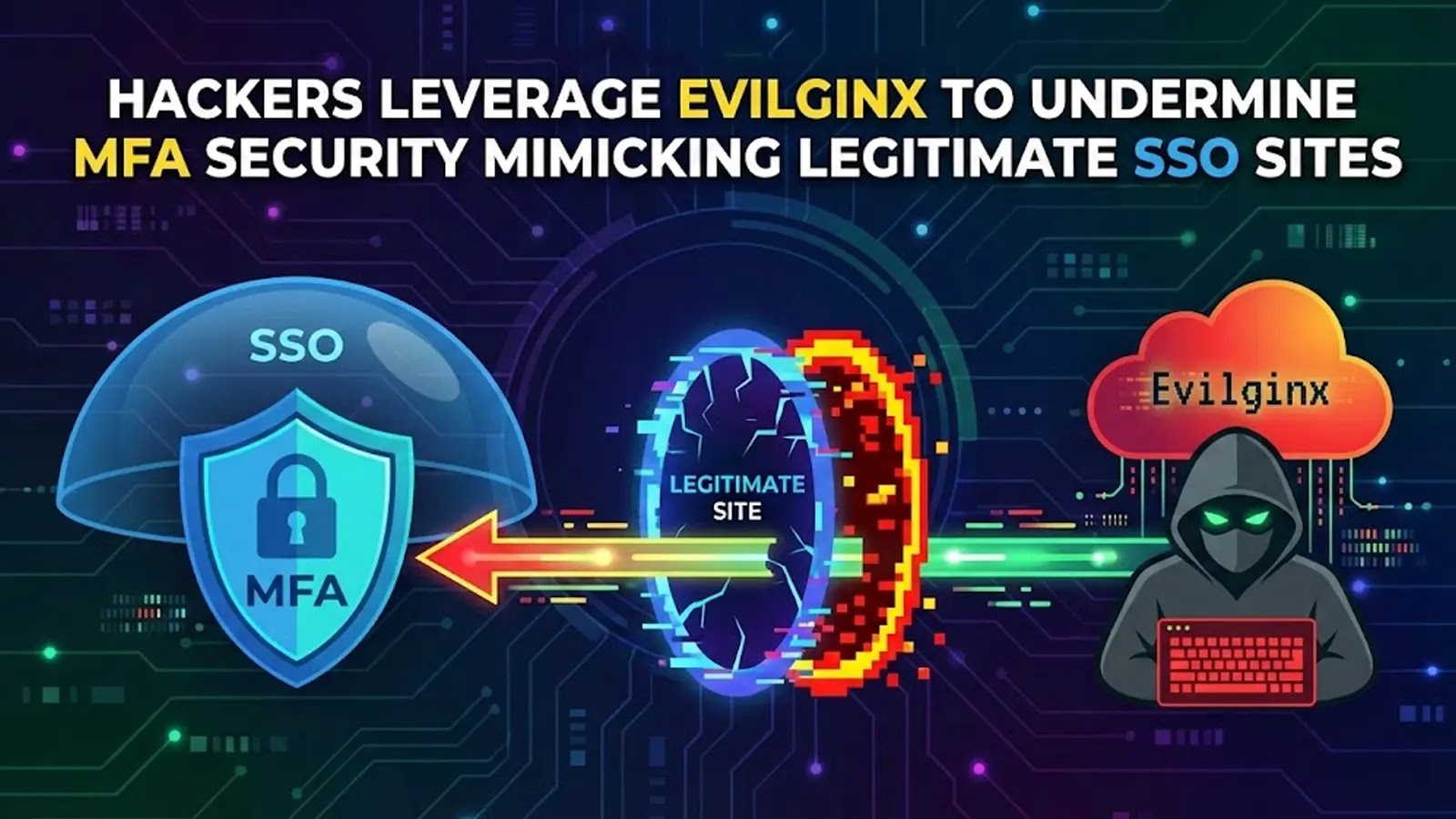
Hackers are increasingly employing a sophisticated adversary-in-the-middle tool known as Evilginx to bypass multi-factor authentication (MFA) and compromise cloud accounts. This advanced toolkit effectively mimics legitimate single sign-on (SSO) portals, presenting a deceptive interface to users and allowing attackers to steal session cookies and tokens.
Infoblox security analysts have observed recent campaigns where Evilginx has been specifically used to impersonate corporate SSO sites, targeting users for their email and collaboration platform access. The framework operates by establishing a reverse proxy, positioning itself between the victim and the authentic SSO provider. This allows malicious actors to intercept credentials and subsequent MFA codes, ultimately gaining unauthorized access to user sessions.
Evilginx: Undermining MFA Security
The core of the Evilginx attack lies in its ability to create highly convincing phishing pages. These fake portals meticulously replicate the appearance, scripts, and user flows of legitimate identity platforms, including enterprise-grade SSO gateways. Users, presented with familiar branding and seemingly valid security certificates, are often unaware they are interacting with a malicious site.
Once a victim enters their username and password, and subsequently completes the MFA challenge, Evilginx captures the crucial session cookies and authentication tokens. Crucially, the tool continues to relay traffic to the legitimate provider, maintaining the illusion of a successful login for the user. However, the stolen cookies and tokens grant attackers access to the user’s active session, bypassing the need for passwords or MFA codes in future access attempts.
This shift from direct credential theft to session hijacking presents a significant challenge for security teams. With an active session token, attackers can perform a wide range of malicious activities. These include reading sensitive emails, initiating password resets on linked applications, configuring new MFA methods to maintain persistent access, and deploying backdoors for long-term, stealthy infiltration.
Attack Analysis and Evasion Techniques
The effectiveness of Evilginx stems from its advanced evasion techniques, designed to circumvent traditional security monitoring. The framework’s ability to forward all content from the legitimate SSO site, including dynamic scripts and styling, renders many visual inspection methods ineffective. Furthermore, the use of valid TLS certificates on lookalike domains ensures that the browser padlock icon remains green, providing a false sense of security to the user.
Beneath the surface, Evilginx meticulously proxies and rewrites HTTP headers. This process allows it to sustain the user’s session with the legitimate service while simultaneously stripping and exfiltrating sensitive session cookies. A simplified representation of the phishlet configuration highlights how attackers intercept data at the proxy layer, capturing session information before it is secured by the user’s device or corporate security solutions.
The implications of these attacks are far-reaching, potentially leading to sophisticated business email compromise (BEC) schemes, extensive data theft, and prolonged undetected access to corporate networks. The attack flow demonstrates how a single successful phishing click can unlock a cascade of downstream services, making attribution and remediation significantly more difficult.
Security analysts emphasize that the success of Evilginx underscores the need for continuous vigilance and layered security approaches. While MFA remains a critical defense, its effectiveness can be diminished if not paired with robust phishing detection, user education, and advanced threat monitoring that can identify anomalies in session activity.
The ongoing evolution of tools like Evilginx suggests that attackers will continue to refine their methods for bypassing authentication mechanisms. Organizations must remain proactive in updating their security postures, investing in advanced detection capabilities, and fostering a security-aware culture among their employees to counter these emerging threats.