


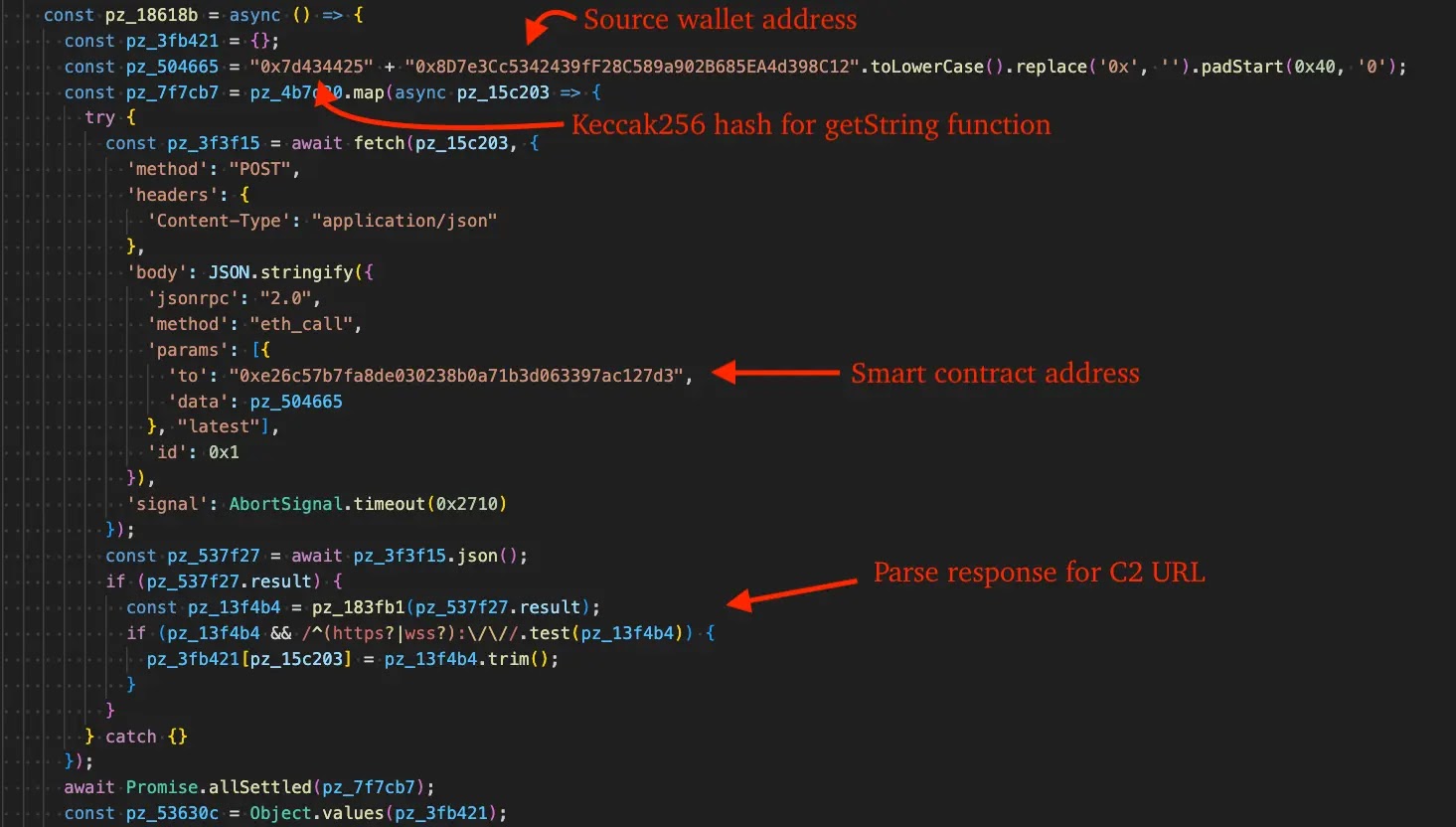
A sophisticated piece of malware, recently identified as EtherRAT, is employing the Ethereum blockchain to conceal its command-and-control (C2) infrastructure. This novel approach significantly complicates detection and disruption efforts by cybersecurity professionals. Identified by researchers, EtherRAT’s ability to leverage a decentralized ledger for its operational backbone poses a novel challenge in the ongoing battle against sophisticated cyber threats.
The malware, built on Node.js, grants attackers extensive remote access to compromised systems. This allows for the execution of arbitrary commands, theft of cryptocurrency wallets, and the exfiltration of cloud credentials with a reduced risk of detection. Sysdig has linked EtherRAT to a North Korean advanced persistent threat (APT) group, noting substantial alignment with the “Contagious Interview” campaign. This campaign pattern involves threat actors posing as recruiters or tech support personnel to deliver malicious payloads.
How EtherHiding Powers Persistent C2 Communication
The distinctive technical feature of EtherRAT is its “EtherHiding” mechanism, designed to ensure persistent C2 communication even when defenders attempt to sever established links. Upon execution, EtherRAT queries multiple public Ethereum RPC providers and selects the most consistent response as its active C2 address.
Operators can dynamically update the C2 server address by interacting with the associated Ethereum smart contract. This is achieved through a `setString` function call, enabling them to redirect all infected machines to new infrastructure without the need to redeploy the malware itself. This adaptability allows the threat actors to maintain control and resilience against takedown efforts.
To evade network-level scrutiny, EtherRAT disguises its outgoing traffic to appear as legitimate Content Delivery Network (CDN) requests. The generated beacon URLs mimic standard static file requests, incorporating random hexadecimal paths, UUIDs, and common file extensions such as `.ico`, `.png`, or `.css`. This camouflage helps blend malicious traffic with benign internet activity.
Furthermore, EtherRAT exhibits a proactive defense against signature-based detection by sending its own source code to the C2 server. The server then returns a freshly obfuscated version of the malware, which overwrites the existing file on the compromised machine. This continuous scrambling ensures that the malware remains one step ahead of signature-based antivirus solutions.
Persistence on compromised Windows systems is established by creating an entry in the Windows registry’s Run key. This entry is assigned a randomly generated 12-character hexadecimal name to circumvent pattern-based detection. The malware then executes silently in headless mode via `conhost.exe`, minimizing visible activity on the infected machine.
Attack Vectors and Mitigation Strategies
Initial access into victim environments for EtherRAT deployment varies, though two primary methods have been observed. In some instances, attackers employ a technique known as ClickFix, which facilitates indirect command execution through the Windows component `pcalua.exe`. This allows the malware to silently retrieve and execute a malicious HTA script from a compromised website.
In other frequently observed cases, attackers impersonate IT support staff on platforms like Microsoft Teams. They then leverage the remote assistance tool QuickAssist to gain unauthorized access to the victim’s machine. Both these methods rely on social engineering and human deception rather than exploiting software vulnerabilities, meaning even systems with up-to-date patches remain susceptible.
The consistent appearance of the same Ethereum smart contract address across multiple compromised environments indicates a well-organized, multi-sector campaign rather than isolated incidents. Targets have spanned critical industries including retail, finance, software development, and business services, underscoring the widespread nature of this threat.
To counter this evolving threat, cybersecurity teams are advised to implement several proactive measures. Disabling `mshta.exe` and `pcalua.exe` through application control policies like AppLocker or Windows Defender Application Control (WDAC) can hinder initial access vectors. Additionally, restricting access to the Run prompt via Group Policy and conducting comprehensive employee awareness training on IT support scams and social engineering tactics is crucial.
From a technical standpoint, blocking corporate network access to cryptocurrency RPC providers can preempt the establishment of EtherHiding-based C2 communication. The deployment of advanced security solutions such as Next-Generation Antivirus (NGAV) or Endpoint Detection and Response (EDR) remains essential for timely detection and containment of infections.
The ongoing nature of this threat suggests that attackers will continue to refine their evasion techniques. Organizations should remain vigilant and prepared to adapt their security postures in response to new developments in malware infrastructure and attack methodologies. The reliance on decentralized technologies for C2 communication presents a persistent challenge, requiring continuous innovation in threat intelligence and defensive strategies.