


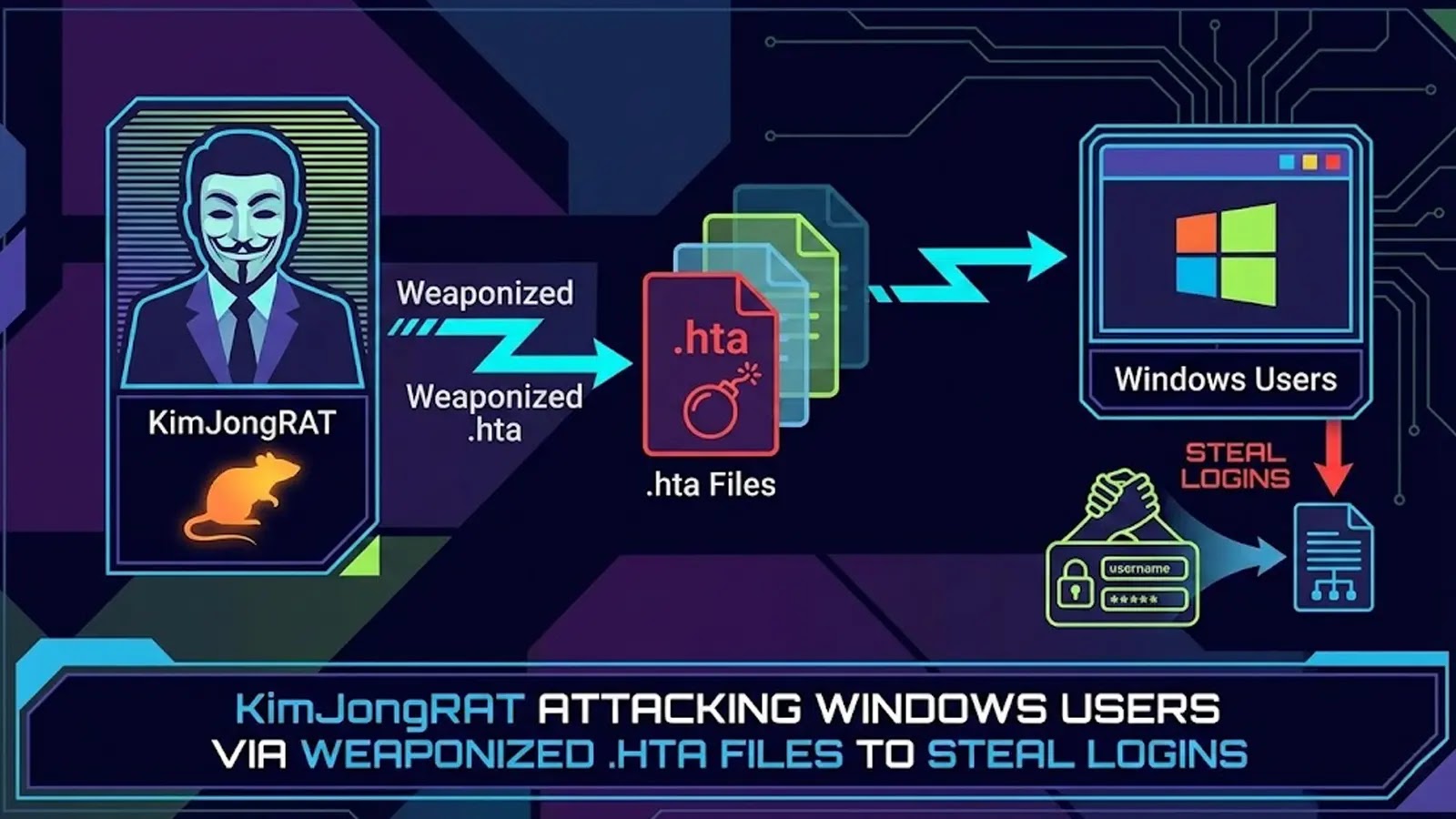
A new remote access trojan (RAT) dubbed KimJongRAT is actively targeting Windows users, posing a significant cybersecurity threat. Security researchers have identified this sophisticated malware as a tool of the Kimsuky group, a China-linked threat actor with alleged state sponsorship. The campaign typically begins with a deceptive phishing email containing an archive disguised as a “National Tax Notice.” Opening this archive initiates a complex infection chain designed to steal sensitive user credentials and data.
The KimJongRAT malware employs a multi-stage approach to compromise victim systems and evade detection. This advanced persistent threat (APT) demonstrates a concerning level of adaptability, significantly complicating defensive measures. Understanding its methodologies is crucial for Windows users to protect themselves from its widespread data exfiltration capabilities.
KimJongRAT: A Sophisticated Attack Vector for Credential Theft
The initial entry point for KimJongRAT is a carefully crafted lure. Upon receiving a phishing email, unsuspecting victims are enticed to open an archive file named “National Tax Notice.” Inside this archive, users encounter a shortcut file that masquerades as a legitimate PDF document, further enhancing the deceptive nature of the attack. This seemingly innocuous file is the first step in a carefully orchestrated infection process.
When the shortcut file is executed, it triggers a hidden command. This command decodes a Base64-encoded URL and leverages the legitimate Microsoft HTML Application (HTA) utility. This technique allows the malware to stealthily contact a remote server, circumventing many standard security protocols. The HTA utility is then used to download an additional payload, identified as “tax.hta,” which forms the next critical stage of the KimJongRAT attack.
Security analysts at Alyac have noted that the loader script is implemented in VBScript and incorporates advanced evasion techniques. One notable tactic involves utilizing legitimate cloud services, such as Google Drive, to host its malicious components. This strategy allows the malware to blend in with normal network traffic, making it harder to detect by security solutions. The loader script is responsible for retrieving both decoy documents, further misleading the user, and the actual malicious binaries required to execute the subsequent phases of the attack.
Exfiltration of Sensitive Data Remains a Primary Objective
The overarching goal of the KimJongRAT campaign is the large-scale exfiltration of sensitive personal and financial information from compromised Windows systems. The malware is designed to cast a wide net, targeting a broad spectrum of data. This includes detailed system information, stored browser data, and crucial encryption keys. Of particular concern is the malware’s specific focus on cryptocurrency wallet information and credentials for popular communication platforms like Telegram and Discord.
The targeted theft of cryptocurrency wallet details makes KimJongRAT a highly dangerous tool for financial fraud and identity theft. The ability to compromise communication platforms further enables attackers to engage in social engineering attacks, phishing, or to maintain persistent access to user networks. The implications for individuals and organizations are severe, ranging from direct financial loss to broader reputational damage.
Adaptive Tactics to Evade Security Measures
A key characteristic of KimJongRAT is its adaptive behavior, which allows it to adjust its execution based on the security posture of the target environment. The malware actively checks for the presence and status of Windows Defender before proceeding with its malicious activities. It employs a specific VBScript command, involving `Set exec = oShell.Exec(ss)` and `If InStr(output, “STOPPED”) > 0 Then`, to ascertain if the security service is running.
If Windows Defender is found to be disabled, the malware proceeds to download and execute a file named “v3.log.” This file contains the primary payload that carries out the data exfiltration. In contrast, if Windows Defender is active and detected, KimJongRAT retrieves an alternative file, “pipe.log.” This secondary file is designed to bypass detection mechanisms that would be triggered by the primary payload, showcasing a sophisticated approach to evading security software.
Regardless of the chosen execution path, KimJongRAT ensures its persistence on the compromised system. It achieves this by registering itself within the system registry. This ensures that the malware automatically runs upon system startup, allowing it to periodically transmit stolen data to its command-and-control servers. The continuous nature of this data exfiltration poses an ongoing risk to users until the malware is eradicated from their systems.
The ongoing development and deployment of sophisticated malware like KimJongRAT highlight the persistent threat posed by APT groups. As security measures evolve, so too will the methods employed by these advanced threat actors. Users are advised to maintain vigilance against phishing attempts, keep their operating systems and security software updated, and practice secure online habits to mitigate the risk of infection.