


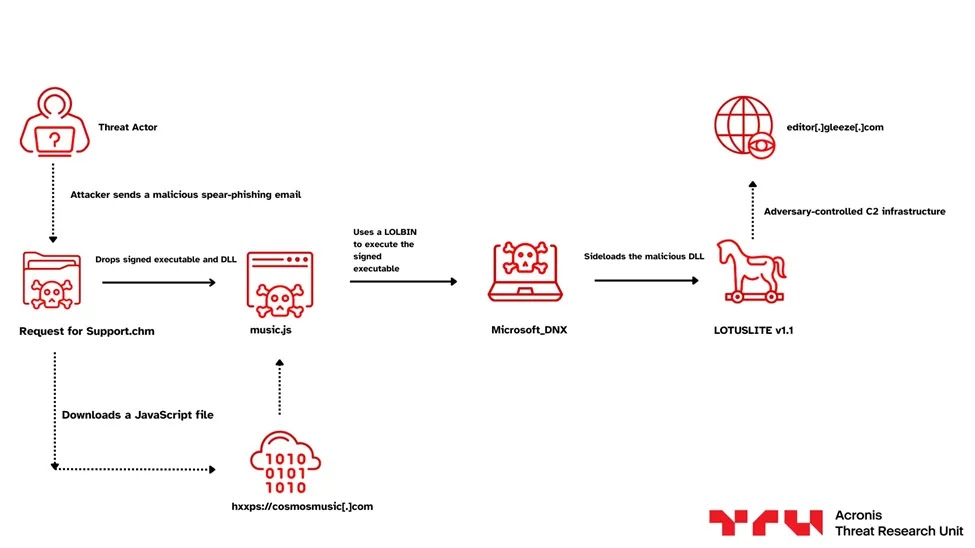
A sophisticated espionage campaign targeting India’s banking sector has been uncovered, with threat actors leveraging a trusted Microsoft-signed binary to infiltrate systems using the LOTUSLITE malware. This discovery highlights a concerning trend of state-linked groups employing advanced techniques to bypass security measures and execute stealthy cyber operations. The campaign, identified by the Acronis Threat Research Unit (TRU), aims to achieve persistent access and data exfiltration, posing a significant risk to financial institutions.
The operation was detected around March, coinciding with geopolitical developments in the West Asian region, according to Acronis TRU analysts. The LOTUSLITE backdoor, a known tool for espionage, was delivered via a method known as DLL sideloading. This technique exploits the inherent trust operating systems place in legitimate, signed executables, making it exceptionally difficult for traditional security software to detect the malicious activity.
DLL Sideloading: Exploiting Trust for Entry
The core infection mechanism in this campaign hinges on the operating system’s trust in digitally signed software. The attack commences with a ZIP archive, seemingly related to India’s banking and financial sector, designed to appear legitimate. Inside this archive, researchers found Microsoft_DNX.exe, a genuine developer tool once part of the older ASP.NET Core ecosystem, and crucially, a malicious DLL file with a matching filename.
When Microsoft_DNX.exe is executed, it attempts to load the associated DLL by name. Because the executable does not perform a full path validation, it readily accepts the malicious DLL placed in the same directory. This allows the attacker-controlled code to execute seamlessly, masked as a legitimate part of the signed Microsoft application. This method bypasses many security solutions that might flag unknown executables but often grant implicit trust to those signed by reputable vendors like Microsoft.
The TRU team emphasized that the use of a Microsoft-signed executable was a deliberate tactic to evade standard endpoint detection mechanisms. Security products are less likely to raise alerts for files verified with a Microsoft signature, making this a highly effective method for initial compromise.
LOTUSLITE Backdoor Operates Stealthily
Once the LOTUSLITE backdoor is established on a compromised system, it exhibits characteristics designed for covert operations. The implant communicates with its command-and-control (C2) server via HTTPS, using a dynamic DNS-based infrastructure. This makes its network traffic appear as standard encrypted web communication, further blending in with normal user activity and evading network security monitoring.
The capabilities of the LOTUSLITE backdoor include remote shell access, file manipulation, and session management. These features provide the threat actor with a persistent foothold within the target organization, enabling them to conduct further reconnaissance and data exfiltration over an extended period. The design of the backdoor strongly suggests espionage-driven objectives, prioritizing information gathering and long-term presence over disruptive actions.
Based on shared infrastructure patterns and operational tendencies observed by the TRU team, attribution to the Mustang Panda activity cluster, a China-linked advanced persistent threat (APT) group, is assessed with moderate confidence. This cluster has been historically associated with espionage campaigns targeting various geopolitical interests.
Broader Campaign and Evolving Tactics
This campaign is not isolated; it connects to parallel activities targeting Korean policy and diplomatic communities. Analysts have identified the same LOTUSLITE infrastructure being used in campaigns that reference Korean geopolitical circles. This indicates a broader operational strategy where the threat actor reuses core toolsets and delivery mechanisms, adapting lure materials to match specific target audiences. Such adaptability is a hallmark of sophisticated APT groups like Mustang Panda, who frequently refine their methods.
Evidence of LOTUSLITE’s evolution is also present in this variant. Researchers noted the use of a different C2 magic value within its network packets compared to previous campaigns. This alteration is designed to evade detection rules that might be configured to flag older LOTUSLITE signatures, representing a continuous effort by the threat actors to stay ahead of security defenses.
In response to these evolving threats, security teams are advised to implement robust monitoring for unusual DLL loading activities originating from legitimate Microsoft executables. Application control policies that restrict DLL loading to verified file paths can add a critical layer of defense. Furthermore, endpoint detection tools that prioritize behavioral analysis over simple file reputation are crucial for identifying and mitigating attacks that leverage this type of sophisticated evasion technique.