


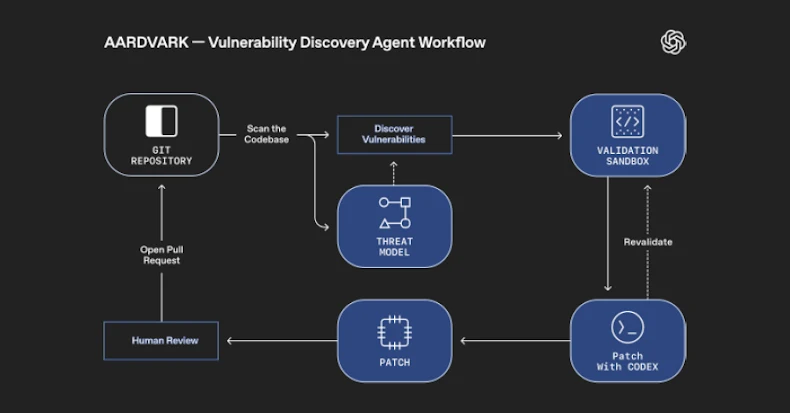
OpenAI has unveiled Aardvark, an innovative “agentic security researcher” powered by its GPT-5 large language model, marking a significant advancement in artificial intelligence for AI code security. Announced on October 31, 2025, the autonomous agent aims to revolutionize how developers and security teams identify and remediate security vulnerabilities at scale. Currently in private beta, Aardvark promises to continuously analyze source code repositories, assess exploitability, prioritize risks, and offer targeted patches, thereby enhancing the security posture of software projects.
Aardvark integrates directly into the software development lifecycle. It monitors code commits and changes, detecting potential security flaws and their associated exploitation risks. Leveraging advanced LLM-based reasoning and tool utilization, the AI then proposes specific fixes for identified vulnerabilities. This proactive approach is designed to bolster security without impeding the pace of innovation.
Aardvark: OpenAI’s Autonomous Security Researcher
The development of Aardvark is underpinned by GPT-5, OpenAI’s sophisticated language model introduced in August 2025. GPT-5 is characterized by its enhanced reasoning abilities and a real-time routing system that selects the most appropriate model based on the nuances of a given task. This cognitive architecture allows Aardvark to not only identify potential issues but also to understand the contextual security objectives and design of a project.
Aardvark operates by first analyzing a project’s codebase to construct a comprehensive threat model. This model serves as a foundational understanding for the agent’s subsequent actions. By examining the repository’s history and scrutinizing incoming code changes, Aardvark can uncover pre-existing vulnerabilities and detect newly introduced ones.
Once a potential security defect is identified, Aardvark attempts to trigger it within an isolated, sandboxed environment. This step is crucial for confirming the exploitability of the vulnerability. Following confirmation, the agent utilizes OpenAI Codex, another of OpenAI’s coding agents, to generate a patch. This patch is then presented to human analysts for review, ensuring a blend of AI efficiency and human oversight in the vulnerability discovery process.
OpenAI reports promising initial results from Aardvark’s deployment across its internal codebases and with select external alpha partners. The agent has already been instrumental in identifying at least 10 CVEs (Common Vulnerabilities and Exposures) within open-source projects, underscoring its capability to detect real-world security weaknesses.
The Growing Trend of AI in Code Security
Aardvark enters a landscape where artificial intelligence is increasingly being leveraged for automated vulnerability discovery and patching. Notably, Google announced its own AI-powered tool, CodeMender, earlier this month. CodeMender is designed to detect, patch, and even rewrite vulnerable code to proactively prevent future exploits. Google has indicated plans to collaborate with maintainers of critical open-source projects to integrate patches generated by CodeMender, aiming to bolster the code vulnerability detection capabilities of these important projects.
These developments, including Aardvark, CodeMender, and other emerging AI agents like XBOW, are being positioned as essential tools for continuous code analysis, exploit validation, and automated patch generation. This surge in AI-driven security solutions follows closely on the heels of OpenAI’s release of the GPT-OSS-Safeguard models, which are specifically fine-tuned for safety classification tasks in open-source software.
“Aardvark represents a new defender-first model: an agentic security researcher that partners with teams by delivering continuous protection as code evolves,” OpenAI stated. The company emphasizes that by identifying vulnerabilities early, validating their exploitability in practical scenarios, and providing clear, actionable fixes, Aardvark can enhance security without hindering development progress. OpenAI’s stated belief is in the widespread expansion of access to advanced security expertise.
The continued development and deployment of Aardvark will be closely watched. The current private beta phase suggests that OpenAI is focused on refining the agent’s capabilities and ensuring its reliability. Future implications for the software development industry include the potential for significantly faster and more comprehensive security patching, potentially reducing the window of vulnerability between the discovery of flaws and their remediation. The effectiveness of Aardvark in the broader open-source ecosystem and its seamless integration into diverse development workflows will be key indicators of its long-term impact.