


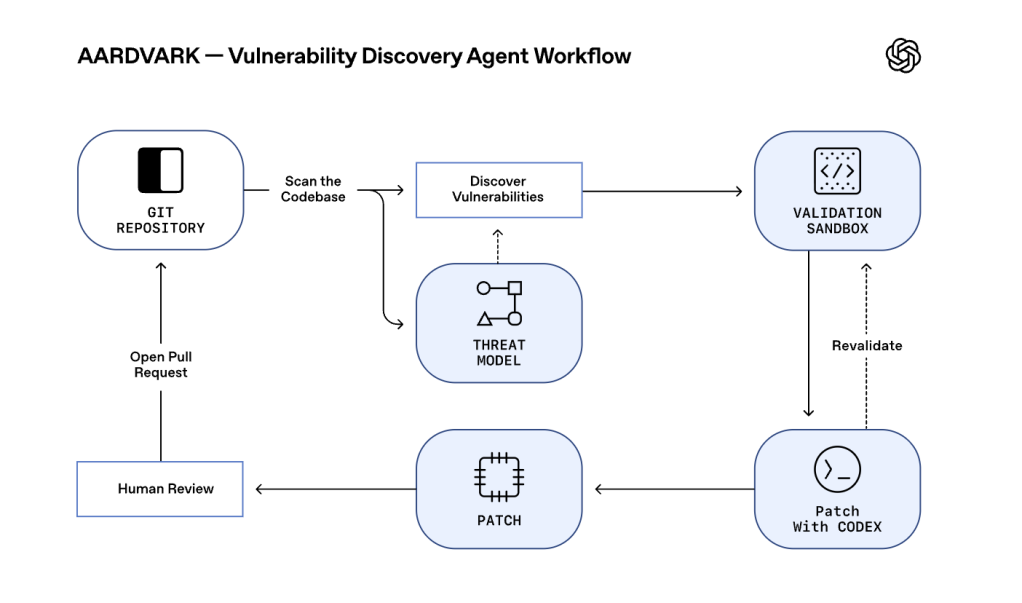
OpenAI has introduced Aardvark, a new artificial intelligence model designed to automate the process of identifying, patching, and remediating software vulnerabilities. The model, powered by GPT-5, was released Thursday and is currently in an invite-only beta phase. Aardvark aims to streamline cybersecurity efforts by continuously scanning code repositories for known weaknesses.
The AI model operates by examining source code to detect vulnerabilities, evaluate their potential impact, and subsequently apply fixes. Unlike traditional methods such as fuzzing or software composition analysis, Aardvark utilizes large language model reasoning and tool integration. OpenAI stated that the model emulates the approach of a human security researcher, involving code analysis, testing, and the use of various tools.
OpenAI’s Aardvark Enhances Automated Vulnerability Scanning
Aardvark’s capabilities extend beyond simple bug detection. According to OpenAI, the model can develop threat models based on project specifics and security objectives. It also has the capacity to sandbox vulnerabilities to test their exploitability, annotate problematic code sections, and generate proposed patches for human review. This comprehensive approach aims to improve overall software security.
In its internal testing, Aardvark has demonstrated significant effectiveness. The company reported that the AI identified 92% of both known and synthetically introduced vulnerabilities in sample code repositories. Additionally, it has the potential to detect logic and privacy bugs. Members of the open-source community operating noncommercial repositories will be granted free access to the Aardvark scanner.
OpenAI’s recent adjustments to its coordinated vulnerability disclosure process, which removed strict timelines, align with the broader ecosystem security focus that Aardvark supports. The company plans to expand the tool’s accessibility as its detection, validation, and reporting functions are further refined.
“By catching vulnerabilities early, validating real-world exploitability, and offering clear fixes, Aardvark can strengthen security without slowing innovation,” OpenAI stated in its announcement. This suggests a goal of balancing robust security with efficient software development cycles.
The Role of AI in Cybersecurity
The introduction of Aardvark underscores the growing role of artificial intelligence in cybersecurity, particularly in automated vulnerability management. Large language models have shown considerable promise in this domain over the past year. OpenAI noted that Aardvark has already identified ten vulnerabilities that have been assigned Common Vulnerabilities and Exposure (CVE) identifiers.
This development follows similar advancements from other organizations. For instance, the startup XBOW has developed AI security models capable of identifying and fixing numerous vulnerabilities, sometimes achieving top rankings in bug bounty programs. These AI-driven tools can operate continuously, augmenting human security efforts.
Experts acknowledge the value of automated systems in addressing the vast number of low-severity bugs that can accumulate in software over time. Such automation can free up human security professionals to focus on more complex and critical vulnerabilities. The chaining of multiple lower-impact flaws is often a key component in sophisticated cyberattacks, making the remediation of these issues crucial.
However, the significant computational resources required to run these advanced AI models present a challenge. One founder of an AI security company noted that the cost of compute for their operation has exceeded the revenue generated from bug bounties. This highlights a potential economic consideration for the widespread adoption of such technologies.
The beta phase for Aardvark is currently limited to select research partners. OpenAI has indicated a phased rollout strategy, with broader access anticipated as the tool’s capabilities mature. Future developments will likely focus on improving the accuracy and efficiency of vulnerability detection, validation, and reporting, alongside addressing the associated computational costs.