


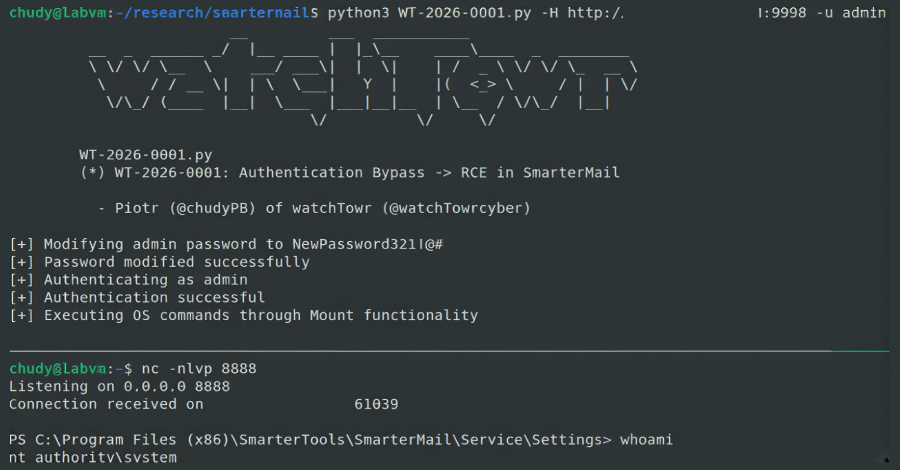
The widely used SmarterTools SmarterMail email software is currently facing active exploitation of a severe security vulnerability. This critical flaw, which allows for authentication bypass and potential remote code execution, is being actively targeted in the wild, just two days after a patch was issued by SmarterTools.
The vulnerability, identified by watchTowr Labs as WT-2026-0001 and currently lacking a CVE identifier, was patched by SmarterTools on January 15, 2026, with Build 9511. This follows a responsible disclosure by watchTowr Labs on January 8, 2026. The flaw enables any authenticated user to reset the SmarterMail system administrator password by sending a specially crafted HTTP request to a specific API endpoint, a process that researchers warn has led to the compromise of email security for some organizations.
SmarterMail Authentication Bypass and Remote Code Execution Flaw
Researchers at watchTowr Labs have detailed the SmarterMail authentication bypass vulnerability, explaining that it can be triggered through a request to the “/api/v1/auth/force-reset-password” endpoint. This function, according to watchTowr Labs researchers Piotr Bazydlo and Sina Kheirkhah, not only allows access without proper authentication but also leverages a boolean flag, “IsSysAdmin,” to determine how to handle the request. This feature, intended for administrative functions, has been turned into a vector for attackers to gain elevated privileges.
When the “IsSysAdmin” flag is set to “true,” the underlying logic for the SmarterMail software proceeds to obtain the configuration for the specified username, create a new system administrator account with a user-defined password, and then update the administrator account with this new password. This bypasses standard security measures, allowing an attacker who knows an existing administrator’s username to effectively take control of the account and the entire SmarterMail system.
However, the implications of this SmarterMail vulnerability extend beyond mere password resetting. The authentication bypass also provides a direct pathway to remote code execution (RCE) through a built-in feature that allows system administrators to execute operating system commands. Attackers can exploit this by navigating to the Settings page, creating a new volume, and specifying arbitrary commands in the “Volume Mount Command” field. These commands are then executed by the host’s operating system, granting the attacker full control over the server.
Exploitation and Patch Circumvention
The decision to publicly disclose the vulnerability was prompted by a report on the SmarterTools Community Portal. A user there claimed to have lost access to their administrator account, with system logs indicating that the “force-reset-password” endpoint was used to change the password on January 17, 2026. This date, significantly, was two days after SmarterTools released the patch for WT-2026-0001. This timeline strongly suggests that attackers were able to reverse-engineer the patch and reconstruct the exploit, highlighting the sophistication of current threat actors targeting email security infrastructure.
Adding to the concern is the vagueness of SmarterMail’s release notes for Build 9511. While they mention “IMPORTANT: Critical security fixes,” they do not explicitly detail the specific vulnerabilities addressed. This lack of specific information makes it difficult for administrators to ascertain which security issues have been resolved and could potentially leave them unaware of active threats.
In response to customer feedback regarding transparency, SmarterTools CEO Tim Uzzanti acknowledged the concern. He indicated that the company’s usual practice, spanning over 23 years, was to communicate security fixes primarily through release notes and critical fix references. Uzzanti stated that to avoid providing ammunition to threat actors, they plan to adopt a new policy of sending emails to administrators whenever a new CVE is discovered and again when a build is released to address it. It remains unclear if SmarterMail administrators received such notifications for this specific vulnerability.
This incident follows closely on the heels of another significant security disclosure related to SmarterMail. Less than a month prior, the Cyber Security Agency of Singapore (CSA) detailed a maximum-severity security flaw in SmarterMail, identified as CVE-2025-52691 with a CVSS score of 10.0, which also allowed for remote code execution. The repeated discovery of such critical vulnerabilities underscores the ongoing need for vigilance in securing email systems.
Organizations utilizing SmarterMail are strongly advised to ensure they have applied the latest patch, Build 9511, and to monitor their systems for any signs of unauthorized access or suspicious activity. The active exploitation of this vulnerability, even after patching, suggests that administrators must remain proactive in assessing their security posture and staying informed about emerging threats to their email infrastructure.