


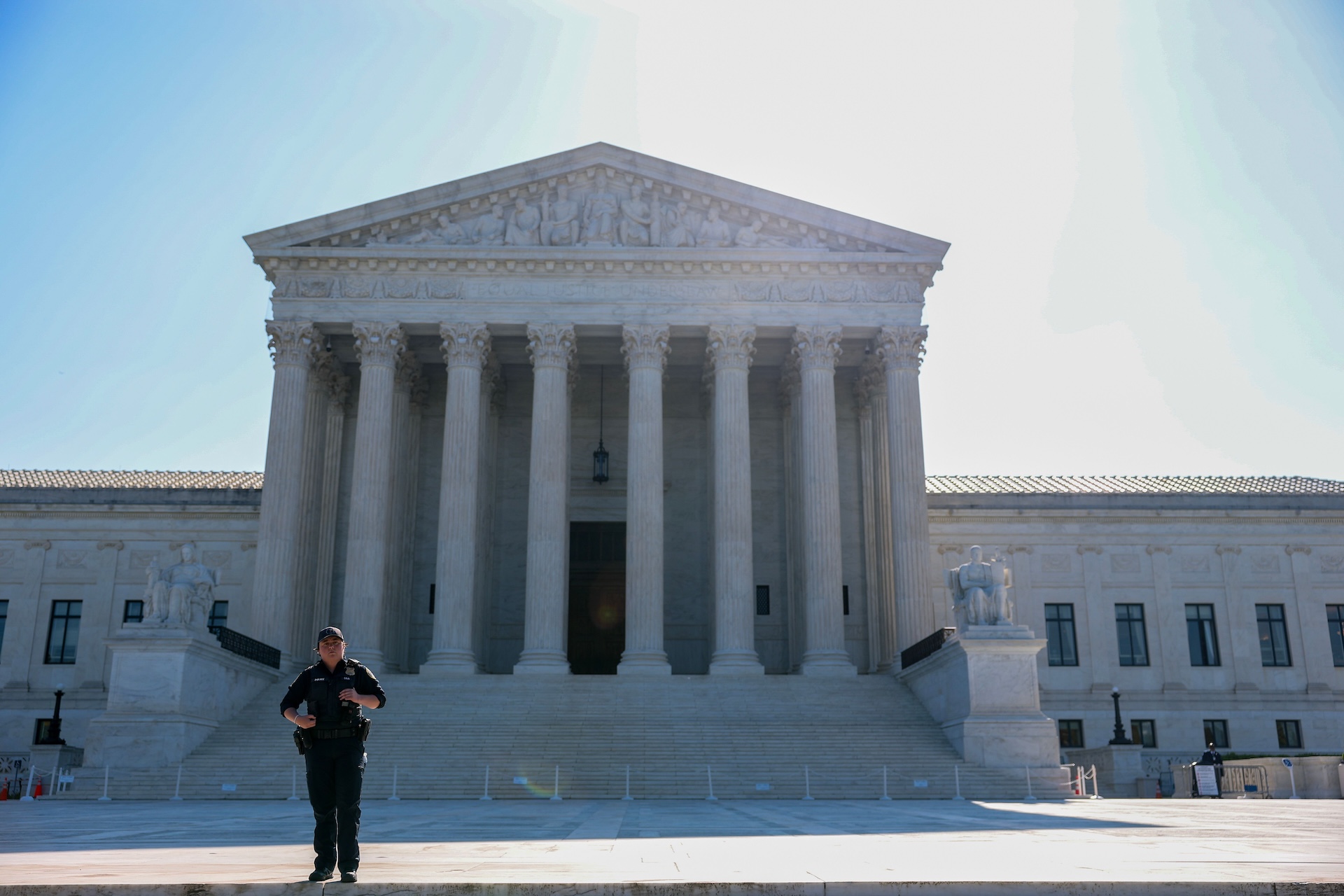
The U.S. Supreme Court heard oral arguments Monday in Chatrie v. The United States, a case that could significantly shape law enforcement’s ability to access vast amounts of Americans’ digital location data. The central question revolves around the constitutionality of geofence warrants, which allow police to query aggregated location data from tech companies like Google to identify individuals present in a specific area at a particular time.
The case originates from the 2019 bank robbery conviction of Okello Chatrie. Prosecutors used a geofence warrant to obtain Google location data from a specific radius around the bank during the time of the robbery, aiming to identify potential suspects. The arguments saw justices across the ideological spectrum posing challenging questions to both the government and the defense.
Examining Geofence Warrants and Fourth Amendment Rights
Justices voiced concerns about whether geofence warrants constituted a violation of Fourth Amendment protections against unreasonable searches. Conservative justices, including Chief Justice John Roberts, questioned the defense’s assertion that individuals have an expectation of privacy in data they have shared with third-party companies. They raised the point that users effectively “opt-in” to data sharing with services like Google.
Adam Unikowsky, representing the petitioner, argued that the government should not be entitled to access such broad datasets. He drew parallels to other sensitive cloud data, questioning whether police should also be able to search emails or calendar entries stored by third parties without a warrant specifically targeting an individual. Unikowsky also contended that users shouldn’t have to disable all location services and cloud features to avoid government surveillance.
Liberal justices also expressed skepticism, acknowledging the specific parameters of a geofence warrant, which is limited in time and space, a characteristic typically associated with lawful warrants. However, Justice Sonia Sotomayor noted the inherent privacy invasion, as location data can follow individuals everywhere, making it impossible to predict when a search might compromise personal privacy.
Uncertainty Pervades Judicial Questioning
During the government’s argument, justices from both ends of the court continued to probe the limits of digital data collection. They questioned the distinction between location data and other electronic information, such as emails and calendar entries, and whether the government’s approach was akin to a physical search of an entire storage facility to find a single item.
The oral arguments were notably lengthy, spanning two hours. Predicting the court’s final decision based on judicial questioning is a complex endeavor, but some insights emerged. Justice Samuel Alito appeared to express doubt about the necessity of the case reaching the Supreme Court, suggesting that the issues were well-trodden and could be better addressed in law review articles.
However, Orin Kerr, a Stanford University law professor who filed a brief supporting the government, interpreted the arguments as leaning towards upholding the legality of geofence warrants, provided they are narrowly tailored in time and location. He believes the Court will likely reject the broader challenges raised by the defense regarding the fundamental lawfulness of such warrants.
Casey Waughn, a privacy lawyer, commented on the relative absence of discussion surrounding the “third-party doctrine,” a legal principle that states individuals generally have no reasonable expectation of privacy in information voluntarily shared with third parties. She highlighted Unikowsky’s arguments, which focused on either a property interest or a reasonable expectation of privacy in cloud data, both of which have historically formed the basis for Fourth Amendment protections.
Alan Butler, executive director for the Electronic Privacy Information Center, emphasized the significant privacy implications of the case. He stated that the Court must decide whether the Constitution protects sensitive digital records generated by our phones, arguing that such data should only be accessed with particularized suspicion and judicial oversight, regardless of where it is stored.
A decision in Chatrie v. The United States is expected by June or July. The ruling will clarify the extent to which law enforcement can utilize location data gathered from tech companies to investigate crimes, potentially impacting digital privacy rights for millions of Americans. The ultimate decision will hinge on how the Court interprets the Fourth Amendment in the context of modern technology and data collection practices.