


The sophisticated hacking group TA416 has escalated its espionage operations across Europe, employing a multi-stage approach that combines subtle web bug reconnaissance with insidious malware delivery. The China-aligned threat actor has been actively targeting government and diplomatic entities, particularly those affiliated with the EU and NATO, since mid-2025. This renewed offensive demonstrates a strategic and patient methodology, meticulously probing for vulnerabilities before launching more impactful attacks.
From mid-2025 through early 2026, TA416 focused its efforts on diplomatic missions across multiple European nations. In a notable shift, the group also expanded its reach to government and diplomatic entities in the Middle East in March 2026, following the conflict in Iran, indicating a clear responsiveness to geopolitical shifts in its targeting strategies. The primary objective appears to be intelligence gathering, rather than financial gain, through the deployment of advanced espionage tools.
TA416 Expands Espionage Operations Across Europe With Web Bug Reconnaissance
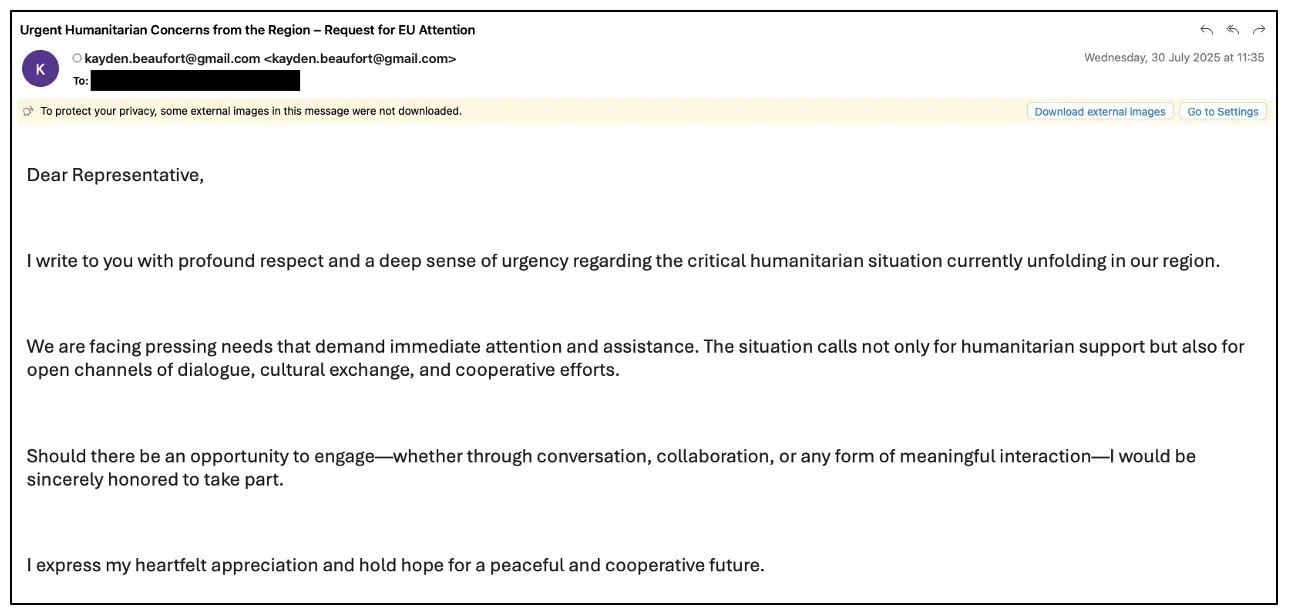
TA416’s current campaign relies on a deceptive tactic: web bug emails originating from free email accounts. These emails employ carefully crafted lures such as humanitarian concerns, interview requests, collaboration proposals, and even seemingly neutral articles to entice diplomatic readers. Each message contains unique tracking URLs or image filenames, allowing the attackers to meticulously monitor which recipients open or click on the embedded links. According to researchers at Proofpoint, the group is leveraging a combination of these web bugs, malicious archive links, compromised email accounts, and even compromised diplomatic or government mailboxes to achieve their objectives.
Throughout the observed period, researchers noted frequent modifications to the initial stages of the infection chain. However, the ultimate goal remained consistent: to deploy a customized PlugX backdoor. This backdoor provides attackers with deep access, enabling them to exfiltrate sensitive data, conduct further reconnaissance, and maintain persistent access to compromised systems. The impact of such operations is significant, as they are designed for long-term intelligence gathering, affording attackers a window into the inner workings of targeted organizations.
The Evolving Infection Chain
A key characteristic of this TA416 campaign is its adaptability in the initial infection vectors, while maintaining a steadfast end goal. Between September 2025 and March 2026, Proofpoint observed the use of fake Cloudflare Turnstile pages, the malicious abuse of Microsoft Entra ID OAuth redirects, and archives containing disguised MSBuild executables coupled with malicious C# project files. This evolution showcases the group’s continuous effort to bypass security measures and social engineer victims.
In an earlier phase, TA416 utilized fake Cloudflare Turnstile pages that mimicked legitimate Microsoft login portals. These led victims to ZIP files hosted on Microsoft Azure Blob Storage. The infection then proceeded via ZIP smuggling and LNK files, culminating in the execution of a signed executable, a malicious DLL, and an encrypted payload designed to load PlugX directly into memory. This layered approach aimed to obscure the malicious activity and make detection more challenging.
TA416 later shifted its tactics, exploiting legitimate Microsoft authorization URLs. By registering third-party Entra ID applications, the group could engineer authorization failures, redirecting victims to attacker-controlled download pages. This method not only lent a veneer of legitimacy to the emails, as the initial link pointed to a trusted Microsoft domain, but also helped circumvent certain URL reputation checks.
By February 2026, the threat actor’s methods evolved once more, incorporating archives hosted on Google Drive or compromised SharePoint sites. These archives contained a renamed MSBuild executable alongside a malicious CSPROJ file. This file was engineered to decode Base64-encoded URLs, download additional sideloading components to the temporary folder, and subsequently launch PlugX through a legitimate executable. This reliance on cloud storage and legitimate system tools highlights the group’s ingenuity in maintaining stealth.
PlugX Enhancements and Operational Details
Recent variants of PlugX have exhibited enhanced evasion techniques and improved persistence mechanisms. Proofpoint reported that in March 2026 samples, the sideloading components were copied to a directory named `C:UsersPublicCanon`, and a registry Run key, also named `Canon`, was established for automatic startup. Furthermore, the loader incorporated API hashing, obfuscation with junk code, and control-flow flattening to significantly impede reverse engineering efforts.
Once operational, the PlugX backdoor communicates with its command and control (C2) servers using HTTP-based traffic, with RC4 encryption applied to communications to mask its activity. The malware readily transmits basic host details to the C2 server and supports a range of commands. These commands include downloading additional malicious payloads, adjusting operational timing parameters, establishing a reverse shell for direct system access, or initiating its own uninstallation to cover its tracks.
Organizations operating in sectors susceptible to sophisticated espionage campaigns, such as government agencies and diplomatic missions, should treat diplomatic-themed emails with extreme caution. Similarly, unsolicited cloud-hosted archives and Microsoft login links that unexpectedly trigger downloads should be considered high-risk. Proactive defense strategies should include robust filtering for file types like LNK, ZIP, RAR, and project files, alongside blocking unnecessary MSBuild execution. Continuous monitoring of Run registry entries and diligent hunting for PlugX-like HTTP traffic are also recommended measures to mitigate exposure. Disabling automatic external image loading where feasible and sandboxing archives sourced from cloud links can further diminish the effectiveness of TA416’s web bug reconnaissance and early-stage delivery tactics.