


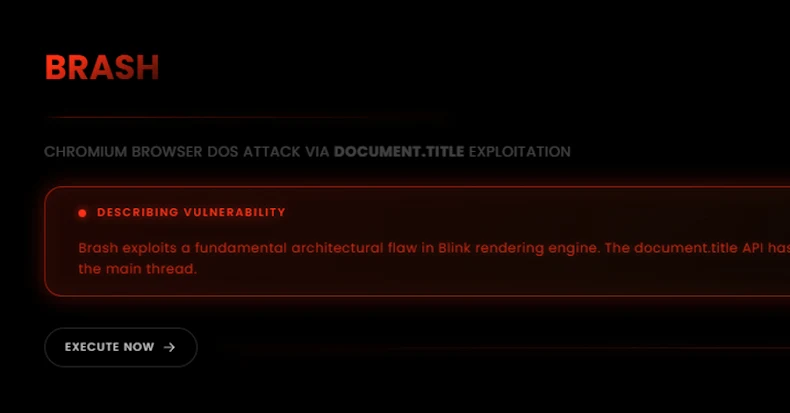
A severe security flaw dubbed “Brash” has been discovered in the Chromium rendering engine, capable of crashing numerous popular Chromium-based browsers within seconds. Security researcher Jose Pino disclosed the details of this vulnerability, highlighting its potential to disrupt user experience and impact browser stability across a wide range of applications.
The Brash vulnerability exploits a fundamental architectural weakness in how the Document Object Model (DOM) handles certain operations, specifically updates to the document’s title. This flaw allows for a rapid-fire bombardment of DOM mutations, overwhelming the browser’s processing capabilities and leading to a complete system freeze or crash. The extensive reach of Chromium-based browsers means this vulnerability affects a significant portion of the internet user base.
Understanding the Brash Vulnerability
At its core, the Brash vulnerability stems from a lack of rate limiting on the `document.title` API. This absence allows malicious code to inject an overwhelming number of updates to the browser tab’s title in rapid succession. As the browser engine attempts to process these excessive changes, it consumes excessive CPU resources, ultimately leading to its unresponsiveness and subsequent termination. This exploit can also degrade overall system performance as it diverts significant processing power.
The attack mechanism, as detailed by security researcher Jose Pino, unfolds in three distinct phases:
The first phase involves the preparation or hash generation. Here, an attacker primes the browser’s memory with a collection of unique hexadecimal strings. These strings act as seeds for the rapid title modifications, designed to maximize the attack’s impact. The goal is to create data ready for immediate and intense use.
The second phase is the burst injection. During this stage, the attacker executes rapid bursts of three consecutive `document.title` updates. In a default configuration, this can translate to an astonishing rate of approximately 24 million updates per second. This intense barrage is the primary mechanism for overwhelming the browser.
The final phase is the UI thread saturation. The continuous stream of title updates effectively saturates the browser’s main thread, the component responsible for user interface interactions. This saturation renders the browser unresponsive, forcing users to terminate the application manually.
The Temporal Precision of Brash
A particularly concerning aspect of the Brash vulnerability is its ability to be programmed for delayed execution. Jose Pino noted that attackers can embed the malicious code with a temporal trigger, allowing it to lie dormant until a specific, predetermined time. This kinetic timing capability transforms Brash from a simple disruption tool into a precision weapon. Attackers gain control not only over the “what” and “where” of the attack but also the “when,” with millisecond accuracy.
This temporal precision means Brash can function akin to a logic bomb. It can be configured to detonate at a specific moment or after a defined period has elapsed, potentially evading initial detection. In a hypothetical attack scenario, a user might simply click a specially crafted URL, unaware that they are initiating a chain reaction designed to trigger the exploit at a later, opportune moment, leading to unintended and potentially severe consequences.
Impacted Browsers and Future Outlook
The Brash vulnerability affects Google Chrome and a vast ecosystem of browsers built upon the Chromium project. This includes widely used applications such as Microsoft Edge, Brave, Opera, Vivaldi, Arc Browser, Dia Browser, OpenAI ChatGPT Atlas, and Perplexity Comet. In contrast, Mozilla Firefox and Apple Safari are not susceptible to this particular attack, as they are based on the WebKit rendering engine.
The discovery of the Brash vulnerability underscores the ongoing need for robust security measures and rapid patching within the browser development community. The potential for widespread disruption highlights the interconnectedness of the internet’s infrastructure and the critical role of browser security in maintaining online stability and user trust. The cybersecurity community will be closely watching for updates from Google and other affected browser vendors regarding their plans for developing and deploying a fix to mitigate this significant security risk.