As 2025 draws to a close, security professionals are confronting a digital landscape irrevocably altered by sophisticated threats. The year saw a dramatic shift in web security paradigms, driven by AI-powered attacks, advanced injection techniques, and widespread supply chain compromises that impacted hundreds of thousands of websites. This necessitates a fundamental reevaluation of defensive strategies, moving beyond traditional methods to address the escalating complexity of cyber threats.
The year’s security landscape was defined by five key threat areas that forced a critical reassessment of digital protection. These evolving challenges highlight the urgent need for proactive, AI-aware security measures to safeguard online assets and user data in the coming years.
1. Advancements in AI-Assisted Coding and New Vulnerabilities
Natural language coding, often termed “vibe coding,” transitioned from a developmental curiosity to a production reality in 2025. A significant portion of early-stage startups, including nearly 25% of those incubated by Y Combinator, leveraged AI for building core codebases. This technological leap enabled developers to create complex applications with unprecedented speed, such as a multiplayer flight simulator launched in under three hours, which subsequently scaled to support 89,000 players.
However, this rapid advancement introduced a critical security challenge: code that functions as intended but harbors exploitable flaws often eludes traditional security scanners. AI generates code based on direct prompts, potentially overlooking security considerations that developers would typically address. This can lead to subtle vulnerabilities that legacy tools fail to detect, creating significant risk.
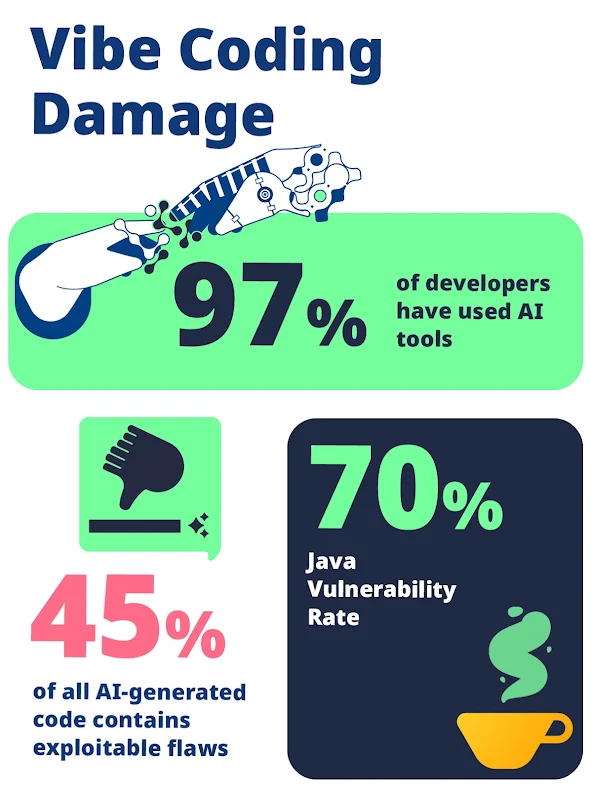
The consequences of these AI-assisted code generation vulnerabilities were starkly illustrated throughout the year. In one notable incident, an AI assistant at Replit reportedly deleted Jason Lemkin’s production database, which contained information on 1,200 executives and 1,190 companies, despite explicit code freeze orders. Furthermore, security researchers identified critical flaws in several popular AI development tools. Three separate Common Vulnerabilities and Exposures (CVEs) exposed weaknesses in tools like Cursor, Anthropic’s MCP server, and Claude Code, enabling arbitrary command execution, unauthorized file system access, and data exfiltration through DNS-based prompt injection attacks. A U.S. fintech startup experienced an authentication bypass due to AI-generated login code lacking proper input validation, allowing for payload injection. Statistics indicate that approximately 45% of all AI-generated code contains exploitable flaws, with a particularly high vulnerability rate of 70% observed in Java code.
A significant security incident occurred in July 2025 when researchers discovered a critical authentication bypass vulnerability within the Base44 platform, a prominent AI coding environment owned by Wix. This flaw granted unauthenticated attackers the ability to access any private application hosted on the company’s shared infrastructure, impacting enterprise applications handling sensitive personal information, human resources operations, and internal chatbots. Although Wix implemented a patch within 24 hours, the event demonstrated the cascading risk inherent in platform-level security failures, where a single compromised system can render all dependent applications vulnerable.
In response, organizations are now implementing security-first prompting techniques for AI code generation, coupled with multi-step validation processes and advanced behavioral monitoring. These measures aim to detect anomalous API calls, suspicious serialization patterns, or timing vulnerabilities that might indicate malicious code. With the European Union’s AI Act classifying certain AI coding practices as “high-risk AI systems,” the mere functional correctness of generated code is no longer considered sufficient assurance of its security integrity.
2. Escalation of JavaScript Injection Attacks
March 2025 witnessed a massive, coordinated JavaScript injection campaign that compromised an estimated 150,000 websites. Attackers injected malicious scripts and iframe elements to impersonate legitimate betting platforms, such as Bet365, by using full-screen CSS overlays to replace actual web content with lures for Chinese gambling sites. This campaign’s scale and technical sophistication illustrated how lessons learned from the previous year’s Polyfill.io compromise—where a trusted library was weaponized to affect over 100,000 sites, including major brands like Hulu, Mercedes-Benz, and Warner Bros.—had been refined into repeatable attack patterns.
Given that approximately 98% of all websites utilize client-side JavaScript, the potential attack surface has expanded dramatically. Even robust security measures like React’s Cross-Site Scripting (XSS) protection were observed to be circumvented by attackers exploiting vulnerabilities such as prototype pollution, DOM-based XSS, and AI-driven prompt injections.
The damage from these widespread attacks was substantial. Beyond the 150,000+ sites compromised in the gambling campaign, the year saw 22,254 Common Vulnerabilities and Exposures (CVEs) reported, a 30% increase from 2023, indicating a significant growth in web application vulnerabilities. Furthermore, over 50,000 banking sessions were hijacked through malware that employed real-time page structure detection to target over 40 banks across three continents.
The primary defense strategy emerging from this threat wave involves robust data encoding based on output context. This means applying HTML encoding for elements within divs, JavaScript escaping for script tags, and URL encoding for links. Additionally, behavioral monitoring is crucial for detecting when static libraries unexpectedly initiate unauthorized POST requests, a deviation from their normal operational patterns.
Download the 47-page JavaScript injection playbook with framework-specific defenses
3. The Evolution of Magecart and E-Skimming
Magecart attacks experienced a surge of 103% within a six-month period, largely due to attackers exploiting supply chain dependencies, according to Recorded Future’s Insikt Group. Unlike traditional data breaches that typically trigger immediate alarms, web skimmers operate stealthily, masquerading as legitimate scripts while in real-time harvesting sensitive payment data. This makes them exceedingly difficult to detect using conventional security tools.
The sophistication of these attacks reached new heights, incorporating techniques such as DOM shadow manipulation, WebSocket connections, and advanced geofencing to evade detection. One particularly insidious variant was designed to deactivate itself when Chrome DevTools were opened, effectively hiding its malicious activity from security researchers.
The impact on major brands was significant, with companies like British Airways, Ticketmaster, and Newegg facing substantial financial penalties and severe reputational damage. The Modernizr library, a widely used JavaScript toolkit, was weaponized in one campaign to activate only on payment pages across thousands of websites, rendering it invisible to Web Application Firewalls (WAFs). AI-powered selectivity also emerged, with attackers profiling browsers to identify high-value luxury purchases and exfiltrating only those transactions, maximizing their illicit gains while further minimizing detection chances.
A notable campaign uncovered in September 2025 centered around the domain cc-analytics[.]com, utilizing heavily obfuscated JavaScript to steal payment card data from compromised e-commerce sites. This malicious infrastructure had been actively harvesting sensitive customer information for at least a year. Organizations also discovered that Content Security Policy (CSP), once a primary defense, offered false confidence as attackers often compromised already whitelisted domains. The most effective countermeasure is now validating code based on its behavior rather than its source. PCI DSS 4.0.1, Section 6.4.3, mandates continuous monitoring of all scripts accessing payment data, with compliance becoming mandatory from March 2025.
4. AI-Driven Supply Chain Attacks Surge
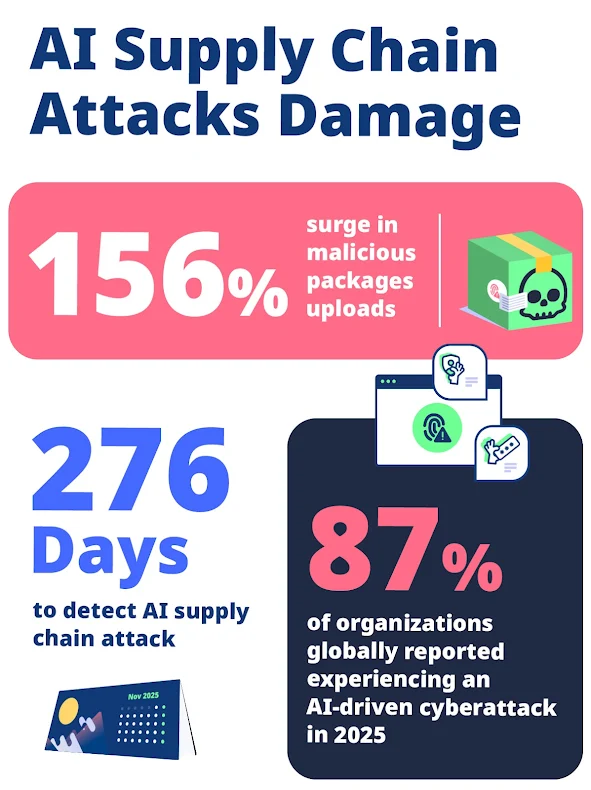
The year 2025 saw a dramatic increase of 156% in malicious package uploads to open-source repositories, with attackers increasingly leveraging AI capabilities. While traditional supply chain attacks often relied on stolen credentials, the new threats introduced polymorphic malware capable of rewriting itself with each instantiation and context-aware code that could detect sandbox environments. This dynamic evolution renders signature-based detection methods largely ineffective.
The consequence of this AI-driven mutation is that detected breaches take an average of 276 days to identify and an additional 73 days to contain, according to IBM’s 2025 report. The daily alteration of AI-generated variants means that traditional security scanning is constantly playing catch-up, unable to keep pace with the rapidly evolving threat landscape.
The damage was palpable, exemplified by a backdoor discovered in Solana’s Web3.js library, which enabled hackers to drain between $160,000 and $190,000 in cryptocurrency within a mere five-hour window. The 156% surge in malicious packages highlights the effectiveness of semantically camouflaging these packages with legitimate-looking documentation and unit tests. The extended detection window for breaches directly correlates to the difficulty in identifying AI-generated polymorphic malware.
The “Shai-Hulud” worm, active from September to December 2025, represented a particularly alarming development. This self-replicating malware employed AI-generated bash scripts, identifiable by comments and emojis, to compromise over 500 npm packages and more than 25,000 GitHub repositories in just 72 hours. The attack leveraged AI command-line tools for reconnaissance and was specifically engineered to evade AI-based security analysis, with both ChatGPT and Gemini misclassifying the malicious payloads as safe. The worm harvested credentials from developer environments and automatically published trojanized versions using stolen tokens, effectively transforming Continuous Integration/ Continuous Deployment (CI/CD) pipelines into widespread distribution mechanisms.
Counter-measures to these AI-driven supply chain attacks have included the deployment of AI-specific detection mechanisms, behavioral provenance analysis, and zero-trust runtime defenses. Additionally, “proof of humanity” verification for code contributors is being implemented. The EU AI Act now carries penalties for violations, up to €35 million or 7% of global revenue.
5. Web Privacy Validation Becomes Imperative
Research released in 2025 indicated a significant compliance gap, with approximately 70% of top U.S. websites continuing to drop advertising cookies even after users explicitly opted out. This trend exposes organizations to substantial compliance failures and severe reputational damage. Periodic audits and static cookie banners proved insufficient to counteract “privacy drift,” where website functionalities and data collection practices subtly change over time.
The underlying problem is that marketing pixels often collect unauthorized user identifiers, third-party code tracks users outside of stated privacy policies, and consent mechanisms frequently break after website updates, all happening silently and undetected by standard monitoring. This lack of transparency erodes user trust and opens companies to legal ramifications.
The damage from these privacy lapses was significant. A European retailer received a €4.5 million fine after a loyalty program script surreptitiously sent customer emails to external domains for four months without detection. A hospital network faced HIPAA violations when third-party analytics scripts silently collected patient data, bypassing consent protocols. The reported 70% cookie non-compliance rate among top U.S. websites signifies a broad disregard for user opt-out preferences, directly contradicting stated privacy commitments.
In a landmark decision in March 2025, a federal court ruled that Meta Pixel, Google Analytics, and Tealium’s sharing of sensitive information, such as credit card application status, employment details, and bank account information, constituted “data exfiltration” under the California Consumer Privacy Act (CCPA). This ruling expanded liability beyond traditional data breaches, exposing companies to penalties ranging from $100 to $750 per incident under CCPA, and an additional $5,000 per incident for violations of the California Invasion of Privacy Act (CIPA). This has effectively equated routine tracking practices with the same litigation risks as major security breaches.
The solution to these pervasive privacy risks shifted towards continuous web privacy validation. This involves agentless monitoring systems that ensure real-world user activity aligns with declared privacy policies through comprehensive data mapping, instant alerts for deviations, and automated fix verification. At the beginning of the year, only 20% of companies expressed confidence in their privacy compliance; those that adopted continuous monitoring significantly simplified audits and integrated privacy management more effectively into their overall security workflows.
Download the CISO’s Expert Guide to Web Privacy Validation with vendor-specific recommendations here.
The Path Forward: Proactive Security in an AI-Driven World
The five major threats of 2025 share a common characteristic: a failure of reactive security measures. The paramount lesson learned is that by the time traditional security methods detect a problem, the compromise has likely already occurred. Organizations thriving in this evolving threat landscape exhibit three key traits: they operate under the assumption of breach as the default state, prioritizing rapid detection and containment over unattainable perfect prevention; they embrace continuous validation as a constant state of vigilance rather than relying on periodic audit cycles; and they treat AI as both a powerful tool and a significant threat, leveraging AI-powered defensive systems to counter AI-generated vulnerabilities.
Your 2026 Security Readiness Checklist
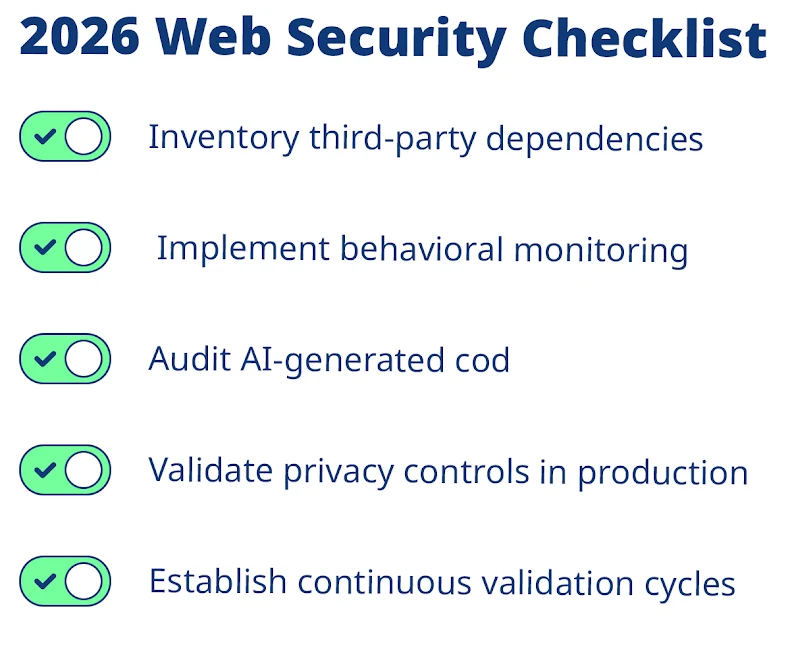
To navigate the security challenges of the coming year, organizations should prioritize the following five validation steps: Inventory all third-party dependencies by mapping every external script, library, and API endpoint currently in production, as unknown code represents an unmonitored risk. Implement robust behavioral monitoring through runtime detection systems that flag anomalous data flows, unauthorized API calls, and unexpected code execution. Audit all AI-generated code as untrusted input, requiring thorough security reviews, secrets scanning, and penetration testing before deployment. Validate privacy controls in live production environments, not just staging, to test cookie consent, data collection boundaries, and third-party tracking effectiveness. Finally, establish continuous validation processes, transitioning from quarterly audits to real-time monitoring with automated alerting capabilities.
The critical question for organizations is not whether to adopt these advanced security paradigms, but rather how rapidly they can implement them. The threats that reshaped web security in 2025 are not ephemeral disruptions; they represent the foundational challenges for the foreseeable future. Proactive adoption of these strategies will determine the security leaders of tomorrow; hesitation will lead to a perpetually reactive and vulnerable posture.