



Active Directory (AD) is the cornerstone of authentication for over 90% of Fortune 1000 companies. As organizations increasingly adopt hybrid and cloud infrastructures, AD’s significance has only grown, alongside its inherent complexity. Every application, user, and device relies on AD for authentication and authorization, making it the ultimate target for cyber attackers. Compromising Active Directory grants attackers the keys to the entire network.
Why Attackers Target Active Directory
Active Directory acts as the central gatekeeper for an organization’s digital assets. When adversaries gain control of AD, they obtain privileged access that allows them to create new accounts, alter existing permissions, disable crucial security controls, and execute lateral movements across the network with minimal detection. This privileged access bypasses many standard security alerts, making AD a highly sought-after target.
The recent Change Healthcare breach in 2024 serves as a stark example of the devastating consequences of an Active Directory compromise. In this incident, attackers exploited a server lacking multi-factor authentication, successfully pivoting to AD, escalating their privileges, and subsequently launching a highly disruptive and costly cyberattack. The attack halted patient care, exposed sensitive health records, and resulted in the payment of millions in ransom. Once attackers control AD, they effectively control the entire network infrastructure, and conventional security tools often struggle to identify these attacks as they mimic legitimate AD operations.
Common Attack Techniques Exploiting Active Directory
Attackers employ various sophisticated techniques to exploit Active Directory. Golden Ticket attacks, for instance, involve generating counterfeit authentication tickets that grant complete domain access for extended periods. DCSync attacks leverage replication permissions to directly extract password hashes from Domain Controllers. Kerberoasting targets service accounts with weak passwords to gain elevated privileges. These methods highlight the critical need for robust defenses around AD.
How Hybrid Environments Expand the Attack Surface
Organizations operating with hybrid Active Directory environments face challenges that were less prevalent just a few years ago. The identity infrastructure now spans on-premises Domain Controllers, Azure AD Connect synchronization, cloud identity services, and a multitude of authentication protocols. This expanded and fragmented environment presents a larger attack surface for adversaries to exploit.
Attackers are adept at exploiting this complexity, often abusing synchronization mechanisms to pivot between on-premises and cloud environments. Compromised OAuth tokens in cloud services can provide backdoor access to on-premises resources, bypassing traditional perimeter defenses. Furthermore, the continued use of legacy protocols like NTLM for backward compatibility offers intruders opportunities for easy relay attacks. This fragmented security posture is exacerbated by the typical deployment of disparate security tools for on-premises and cloud environments, leading to visibility gaps at the intersection of these systems. Threat actors thrive in these blind spots while security teams struggle to correlate events across different platforms.
Common Vulnerabilities Exploited in Active Directory
The Verizon Data Breach Investigation Report consistently highlights compromised credentials as a primary vector in breaches, involved in 88% of incidents. Cybercriminals actively harvest these credentials through various means, including phishing, malware, brute-force attacks, and the purchase of credentials from breached databases. This reliance on compromised credentials underscores the importance of securing user accounts within Active Directory.
Frequent Vulnerabilities in Active Directory
Several common vulnerabilities within Active Directory are frequently exploited by attackers. Weak passwords remain a significant issue, often stemming from users reusing the same credentials across personal and work accounts, thereby exposing multiple systems to risk if one account is compromised. Standard eight-character complexity rules, while seemingly robust, can often be cracked by attackers in mere seconds. Service accounts also present a considerable risk; they frequently utilize passwords that never expire or change and often possess excessive permissions, facilitating lateral movement once compromised. Additionally, cached credentials stored in workstation memory can be easily extracted by attackers using standard tools. A lack of visibility into who uses privileged accounts, their exact access levels, and when these accounts are utilized further compounds these risks. Finally, stale access, where former employees retain privileged access long after their departure due to inadequate auditing and removal processes, creates a growing pool of exploitable accounts.
The threat landscape continues to evolve, with new vulnerabilities emerging regularly. The April 2025 discovery of a critical AD flaw enabling privilege escalation from low-level access to system-level control serves as a reminder. While Microsoft released a patch, many organizations face challenges in rapidly testing and deploying these crucial updates across all their Domain Controllers.
Modern Approaches to Strengthen Your Active Directory
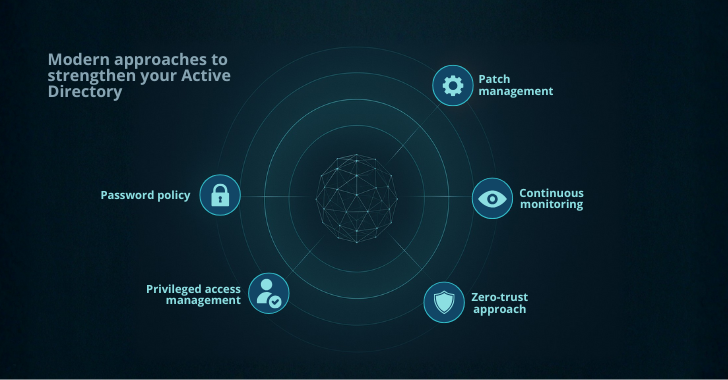
Effectively defending Active Directory requires a layered security approach that addresses credential theft, privileged access management, and continuous monitoring. Implementing these strategies is crucial for mitigating the risks associated with sophisticated cyber threats.
Strong Password Policies Are Your First Defense
Robust password policies are paramount in safeguarding your digital environment. Blocking passwords that appear in known breach databases immediately prevents users from employing credentials that attackers already possess. Continuous scanning can detect when user passwords are compromised in new breaches, providing real-time protection beyond scheduled password resets. Dynamic feedback mechanisms guide users toward creating strong, memorable passwords, enhancing overall security while reducing user frustration.
Privileged Access Management Reduces Your Attack Surface
Implementing comprehensive privileged access management (PAM) strategies is essential for minimizing risk by strictly controlling the use of administrative privileges. Segregating administrative accounts from standard user accounts prevents compromised user credentials from granting administrative access. Enforcing just-in-time (JIT) access ensures that elevated privileges are granted only when needed and are automatically revoked afterward. Routing all administrative tasks through dedicated privileged access workstations further enhances security by preventing credential theft from regular endpoints.
Zero-Trust Principles Apply to Active Directory
Adopting a zero-trust security model strengthens Active Directory defenses by verifying every access attempt, rather than assuming trust within the network. Conditional access policies that evaluate user location, device health, and behavioral patterns before granting access, going beyond simple username and password validation, are key. Requiring multi-factor authentication for all privileged accounts is a critical step in thwarting malicious actors who have stolen credentials.
Continuous Monitoring Catches Attacks in Progress
Deploying tools that meticulously track every significant change within Active Directory, including modifications to group memberships, permission grants, policy updates, and unusual replication activity between Domain Controllers, is vital. Configuring alerts for suspicious patterns, such as multiple failed authentication attempts from the same account or administrative actions occurring at unusual hours, provides early warning signs. Continuous monitoring offers the necessary visibility to detect and disrupt attacks before they escalate into full-blown breaches.
Patch Management Is a Must-Have for Domain Controllers
Robust patch management practices are indispensable for maintaining the security of Domain Controllers. Promptly deploying security updates that close privilege escalation paths, ideally within days rather than weeks, is crucial. Adversaries actively scan for unpatched systems, making timely updates a critical defensive measure.
Active Directory Security Is a Continuous Process
Securing Active Directory is not a one-time project but an ongoing effort. Attackers constantly refine their techniques, new vulnerabilities emerge regularly, and organizational infrastructures evolve. This dynamic threat landscape necessitates continuous attention and improvement in security practices. Passwords remain the most common attack vector, making their robust management a top priority. For the highest level of protection, investing in solutions that continuously monitor for compromised credentials and block them in real-time is essential. Solutions that integrate directly with Active Directory can block compromised credentials before they become a problem, scanning for breached passwords daily to provide real-time protection. Dynamic feedback mechanisms can guide users toward creating strong, memorable passwords, enhancing security and reducing administrative overhead.