


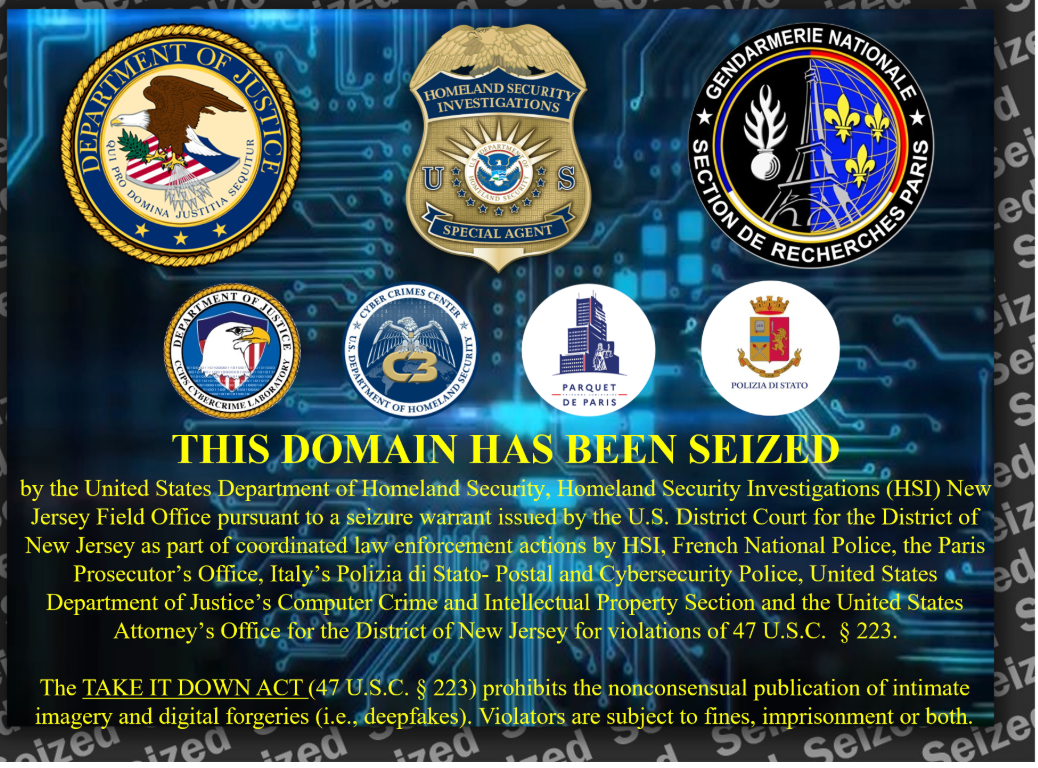
U.S. law enforcement agencies, in collaboration with international partners, have seized multiple internet domains alleged to have hosted nonconsensual AI-generated pornography. The operation targeted websites that specialized in creating and distributing digitally altered images and videos of women without their consent.
The domains, CFAKE.com and SOCFAKE.com, are accused of publishing thousands of explicit images and videos, many depicting public figures, often in nude or sexually suggestive contexts. The U.S. Departments of Justice and Homeland Security led the seizure effort this week.
Seizure of Deepfake Pornography Sites
The domains in question, CFAKE.com and SOCFAKE.com, are alleged to have facilitated the creation and dissemination of nonconsensual explicit content. According to a Department of Justice release, the sites contained images and videos presented as sexual content of famous women, including politicians, royalty, journalists, and entertainers, often with the implication of nudity or sexual activity.
Content categories on the platform reportedly included terms such as “rape,” “forced,” and “degradation,” further highlighting the exploitative nature of the alleged operation. These details were conveyed in a Department of Justice probable cause affidavit and search warrants; the court documents have not been publicly reviewed by CyberScoop.
International Cooperation and the TAKE IT DOWN Act
This operation was carried out under the authority of the TAKE IT DOWN Act, legislation enacted last year to provide federal authorities with the power to prosecute individuals involved in the creation and distribution of deepfake pornography. The law, a product of bipartisan support, was introduced in response to growing concerns over the misuse of artificial intelligence for creating nonconsensual explicit content.
The successful seizure of these domains represents a significant enforcement action since the law went into effect. U.S. Attorney for the District of New Jersey, Robert Fraiser, stated that the operation involved coordination with law enforcement agencies in France and Italy. Italian authorities initially alerted U.S. officials to the website, while a parallel investigation in France led to the arrest of an individual identified as a suspect connected to the site and the seizure of cryptocurrency funds.
“These seizures stopped a website that trafficked in humiliation, exploitation, and the violation of personal privacy on a massive scale,” Fraiser said in a statement. “For the victims whose images were distributed without their consent, the harm is not virtual — it is deeply personal and often enduring.”
Suspect Arrested in France
The Paris Prosecutor’s Office reported the arrest of Cyrille B., a 47-year-old French national, who is accused of administering CFAKE. A search of his residence in Nice yielded computer equipment linked to the website and approximately $48,000 in Ethereum cryptocurrency, believed to be derived from advertising revenue generated by the site.
The French investigation uncovered around 300,000 images and 7,000 videos depicting approximately 14,000 individuals from various countries. The platform reportedly had about 200,000 user accounts, garnered approximately 4 million views monthly, and had 50 new pieces of content uploaded daily.
The suspect, who has no prior criminal record, is scheduled to go to trial on July 7. He faces potential penalties of up to seven years in prison and a fine of €500,000.
The U.S. Immigration and Customs Enforcement’s Homeland Security Investigation division is leading the federal investigation, working in conjunction with the U.S. Attorney’s office for New Jersey.
Looking Ahead
The ongoing investigations will likely focus on identifying any further individuals or networks involved in the creation and distribution of such content. Authorities are expected to continue efforts to dismantle platforms that facilitate the spread of nonconsensual explicit material, particularly that generated using AI technology. The outcomes of the French trial may also provide further insights into the tactics and reach of these operations.